


Page 34 - Azerbaijan State University of Economics
P. 34
THE JOURNAL OF ECONOMIC SCIENCES: THEORY AND PRACTICE, V.72,  # 2, 2015, pp. 32-42


                    country is small enough not to influence world market prices, i.e. it faces fixed world
                    prices for exports and imports.
                         The CGE model employed in this paper is commonly known as a 1-2-3 model.
                    The model developed in this paper, thus, refers to one country with two producing
                    sectors and three goods. The commodities produced by a country are an export good
                    E which is not demanded domestically and sold to foreigners. The second one is a
                    domestic good D which is sold in the country domestically. Finally, the third good is
                    an imported good M which is not produced domestically but imported from abroad.
                         There are three actors in the model which are: a producer, a household, and the rest
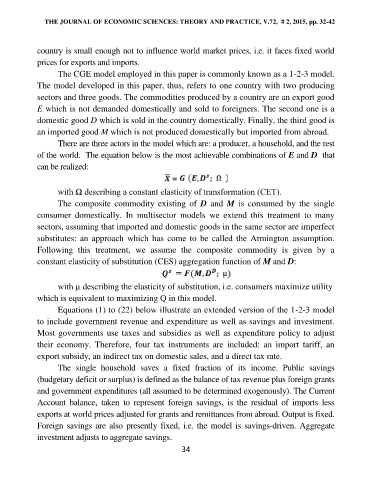
                    of the world.  The equation below is the most achievable combinations of E and D  that
                    can be realized:
                                                         =
                         with Ω describing a constant elasticity of transformation (CET).
                         The  composite  commodity  existing  of  D  and  M  is  consumed  by  the  single
                    consumer  domestically.  In  multisector  models  we  extend  this  treatment  to  many
                    sectors, assuming that imported and domestic goods in the same sector are imperfect
                    substitutes:  an approach which has  come to be  called the Armington  assumption.
                    Following  this  treatment,  we  assume  the  composite  commodity  is  given  by  a
                    constant elasticity of substitution (CES) aggregation function of M and D:


                         with µ describing the elasticity of substitution, i.e. consumers maximize utility
                    which is equivalent to maximizing Q in this model.
                         Equations (1) to (22) below illustrate an extended version of the 1-2-3 model
                    to include government revenue and expenditure as well as savings and investment.
                    Most governments use taxes and subsidies as well as expenditure policy to adjust
                    their  economy.  Therefore,  four  tax  instruments  are  included:  an  import  tariff,  an
                    export subsidy, an indirect tax on domestic sales, and a direct tax rate.
                         The  single  household  saves  a  fixed  fraction  of  its  income.  Public  savings
                    (budgetary deficit or surplus) is defined as the balance of tax revenue plus foreign grants
                    and government expenditures (all assumed to be determined exogenously). The Current
                    Account  balance,  taken  to  represent  foreign  savings,  is  the  residual  of  imports  less
                    exports at world prices adjusted for grants and remittances from abroad. Output is fixed.
                    Foreign savings  are  also  presently  fixed, i.e. the  model is savings-driven.  Aggregate
                    investment adjusts to aggregate savings.
                                                           34

