


Page 49 - Azerbaijan State University of Economics
P. 49
THE JOURNAL OF ECONOMIC SCIENCES: THEORY AND PRACTICE, V.73, # 1, 2016, pp. 45-51


                         Therefore,  the  amount  of  transfers  to  the  state  budget  was  reduced  by  4.27
                    billion USD, or by 35.2% in 2015 compared with previous year.
                         As  presented  in  the  Diagram  above,  starting  from  2006,  the  amount  of
                    transfers from the Fund to the state budget rose rapidly, and reached its maximum in
                    2013. To put it another way, during the period 2005-2013 the volume of transfers
                    increased by 91 times. In 2014 the government reduced the amount of transfers with
                    the purpose of saving. Yet, the sharp decline in fuel prices in 2015 necessitated the
                    reduction.
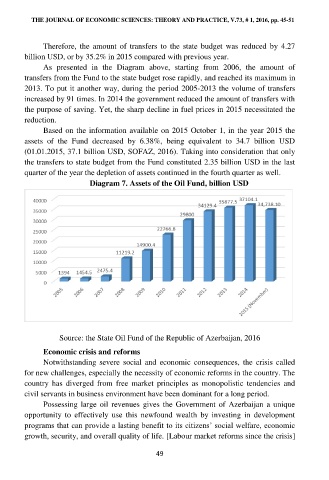
                         Based on the information available on 2015 October 1, in the year 2015 the
                    assets  of  the  Fund  decreased  by  6.38%,  being  equivalent  to  34.7  billion  USD
                    (01.01.2015, 37.1 billion USD, SOFAZ, 2016). Taking into consideration that only
                    the transfers to state budget from the Fund constituted 2.35 billion USD in the last
                    quarter of the year the depletion of assets continued in the fourth quarter as well.
                                       Diagram 7. Assets of the Oil Fund, billion USD


                              Source: the State Oil Fund of the Republic of Azerbaijan, 2016
                         Economic crisis and reforms
                         Notwithstanding  severe  social  and  economic  consequences,  the  crisis  called
                    for new challenges, especially the necessity of economic reforms in the country. The
                    country  has  diverged  from  free  market  principles  as  monopolistic  tendencies  and
                    civil servants in business environment have been dominant for a long period.
                         Possessing large oil revenues  gives the Government of Azerbaijan a unique
                    opportunity  to  effectively  use  this  newfound  wealth  by  investing  in  development
                    programs that can provide a lasting benefit to its citizens‘ social welfare, economic
                    growth, security, and overall quality of life. [Labour market reforms since the crisis]


                                                           49

