


Page 26 - Azerbaijan State University of Economics
P. 26
Evangelos Siskos, Konstantia Darvidou: Trade of the EU with Eastern European countries
                                                                                          (case of Ukraine and Turkey)


                    exports  to  Western  Europe  had  some  seasonality,  while  import  form  the  EU  was
                    more stable across a year.
                         But  there  is  a  lack  of  comparative  studies  for  bilateral  trade  with  several
                    countries, including comparing Turkey and Ukraine as trade partners of the EU.
                         2.  Methodology.  We  analyze  structure  and  trends  of  exports  of  the  EU-28
                    Member States, Ukraine and Turkey as well as their bilateral trade. We use mostly
                    the UNCTAD (2016) data. Eurostat (2016) data is used to analyze bilateral trade in
                    services.
                         First, we analyze the product structures of goods export of the EU, Ukraine
                    and  Turkey  in  order  to  find  out,  whether  they  are  competitors  to  the  existing
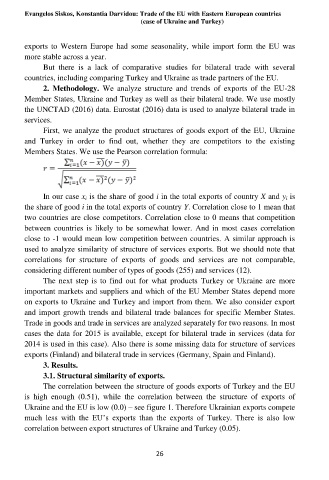
                    Members States. We use the Pearson correlation formula:


                         In our case x i is the share of good i in the total exports of country X and y i is
                    the share of good i in the total exports of country Y. Correlation close to 1 mean that
                    two countries are close competitors. Correlation close to 0 means that competition
                    between  countries  is  likely  to  be  somewhat  lower.  And  in  most  cases  correlation
                    close to -1 would mean low competition between countries. A similar approach is
                    used to analyze similarity of structure of services exports. But we should note that
                    correlations  for  structure  of  exports  of  goods  and  services  are  not  comparable,
                    considering different number of types of goods (255) and services (12).
                         The next  step is  to find out  for what products  Turkey or Ukraine are  more
                    important markets and suppliers and which of the EU Member States depend more
                    on exports to Ukraine and Turkey and import from them. We also consider export
                    and import growth trends and bilateral trade balances for specific Member States.
                    Trade in goods and trade in services are analyzed separately for two reasons. In most
                    cases the data for 2015 is available, except for bilateral trade in services (data for
                    2014 is used in this case). Also there is some missing data for structure of services
                    exports (Finland) and bilateral trade in services (Germany, Spain and Finland).
                         3. Results.
                         3.1. Structural similarity of exports.
                         The correlation between the structure of goods exports of Turkey and the EU
                    is  high  enough  (0.51),  while  the  correlation  between  the  structure  of  exports  of
                    Ukraine and the EU is low (0.0) – see figure 1. Therefore Ukrainian exports compete
                    much  less  with  the  EU‘s  exports  than  the  exports  of  Turkey.  There  is  also  low
                    correlation between export structures of Ukraine and Turkey (0.05).


                                                           26

