


Page 25 - Azerbaijan State University of Economics
P. 25
THE JOURNAL OF ECONOMIC SCIENCES: THEORY AND PRACTICE, V.76, # 2, 2019, pp. 21-30


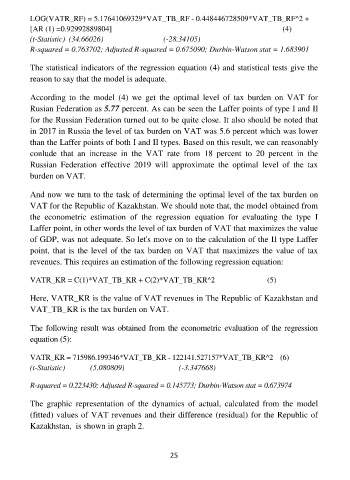
                    LOG(VATR_RF) = 5.17641069329*VAT_TB_RF - 0.448446728509*VAT_TB_RF^2 +
                    [AR (1) =0.92992889804]                                                                                        (4)
                    (t-Statistic)  (34.66026)                               (-28.34105)
                    R-squared = 0.763702; Adjusted R-squared = 0.675090; Durbin-Watson stat = 1.683901

                    The statistical indicators of the regression equation (4) and statistical tests give the
                    reason to say that the model is adequate.

                    According  to  the  model  (4)  we  get  the  optimal  level  of  tax  burden  on  VAT  for
                    Rusian Federation as 5.77 percent. As can be seen the Laffer points of type I and II
                    for the Russian Federation turned out to be quite close. It also should be noted that
                    in 2017 in Russia the level of tax burden on VAT was 5.6 percent which was lower
                    than the Laffer points of both I and II types. Based on this result, we can reasonably
                    conlude  that  an  increase  in  the  VAT  rate  from  18  percent  to  20  percent  in  the
                    Russian  Federation  effective  2019  will  approximate  the  optimal  level  of  the  tax
                    burden on VAT.

                    And now we turn to the task of determining the optimal level of the tax burden on
                    VAT for the Republic of Kazakhstan. We should note that, the model obtained from
                    the  econometric  estimation  of  the  regression  equation  for  evaluating  the  type  I
                    Laffer point, in other words the level of tax burden of VAT that maximizes the value
                    of GDP, was not adequate. So let's move on to the calculation of the II type Laffer
                    point, that is the level of the tax burden on VAT that maximizes the value of tax
                    revenues. This requires an estimation of the following regression equation:

                    VATR_KR = C(1)*VAT_TB_KR + C(2)*VAT_TB_KR^2                  (5)

                    Here, VATR_KR is the value of VAT revenues in The Republic of Kazakhstan and
                    VAT_TB_KR is the tax burden on VAT.

                    The following result was obtained from the econometric evaluation of the regression
                    equation (5):

                    VATR_KR = 715986.199346*VAT_TB_KR - 122141.527157*VAT_TB_KR^2    (6)
                    (t-Statistic)             (5.080809)                            (-3.347668)

                    R-squared = 0.223430; Adjusted R-squared = 0.145773; Durbin-Watson stat = 0.673974

                    The  graphic  representation  of  the  dynamics  of  actual,  calculated  from  the  model
                    (fitted) values of VAT revenues and their difference (residual) for the Republic of
                    Kazakhstan,  is shown in graph 2.


                                                           25

