


Page 35 - Azerbaijan State University of Economics
P. 35
THE JOURNAL OF ECONOMIC SCIENCES: THEORY AND PRACTICE, V.76, # 2, 2019, pp. 31-45


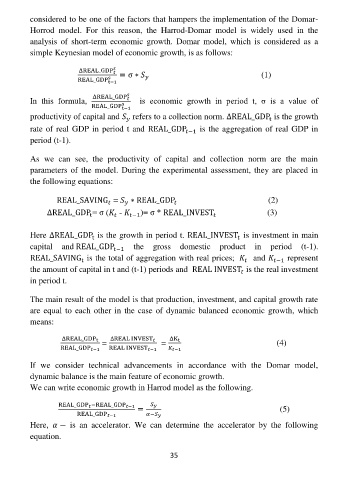
                    considered to be one of the factors that hampers the implementation of the Domar-
                    Horrod  model.  For  this  reason,  the  Harrod-Domar  model  is  widely  used  in  the
                    analysis  of  short-term  economic  growth.  Domar  model,  which  is  considered  as  a
                    simple Keynesian model of economic growth, is as follows:

                                  ΔREAL_GDP        = σ ∗                                                         (1)
                                 REAL_GDP s t−1

                    In  this  formula,   ΔREAL_GDP           is  economic  growth  in  period  t,  σ  is  a  value  of
                                     REAL_GDP s t−1
                    productivity of capital and    refers to a collection norm. ΔREAL_GDP is the growth

                                                                                        t
                    rate of real GDP in period t and REAL_GDP     −1  is the aggregation of real GDP in
                    period (t-1).

                    As  we  can  see,  the  productivity  of  capital  and  collection  norm  are  the  main
                    parameters of the model. During the experimental assessment, they are placed in
                    the following equations:

                           REAL_SAVING  =    ∗ REAL_GDP                                            (2)


                         ΔREAL_GDP = σ (    -      −1 )= σ * REAL_INVEST                         (3)

                                     t


                    Here ΔREAL_GDP is the growth in period t. REAL_INVEST  is investment in main
                                     t

                    capital  and REAL_GDP    −1   the  gross  domestic  product  in  period  (t-1).
                    REAL_SAVING  is the total of aggregation with real prices;       and      −1  represent

                                  t
                    the amount of capital in t and (t-1) periods and  REAL INVEST  is the real investment

                    in period t.

                    The main result of the model is that production, investment, and capital growth rate
                    are equal to each other in the case of dynamic balanced  economic growth, which
                    means:

                               ΔREAL_GDP t   =   ∆REAL INVEST       =   ΔK t                                              (4)
                            REAL_GDP   −1  REAL INVEST   −1       −1

                    If  we  consider  technical  advancements  in  accordance  with  the  Domar  model,
                    dynamic balance is the main feature of economic growth.
                    We can write economic growth in Harrod model as the following.

                            REAL_GDP    −REAL_GDP   −1
                                                  =                                                              (5)
                                 REAL_GDP   −1         −
                    Here,     −  is  an  accelerator.  We  can  determine  the  accelerator  by  the  following
                    equation.

                                                           35

