


Page 78 - Azerbaijan State University of Economics
P. 78
THE JOURNAL OF ECONOMIC SCIENCES: THEORY AND PRACTICE, V.78, # 2, 2021, pp. 74-88


                    I. METHODOLOGY
                    Data Sources
                    The study has used 6-year time series data starting from 2001 to 2017. This is due to
                    the  required  data  series  being  available  only  for  the  2001–2007-year  period.  The
                    annual  data  were  obtained  from  Central  Statistical  Agency,  National  Bank  of
                    Ethiopia  (NBE),  Ethiopian  Economic  Association  (EEA),  National  planning
                    commission, and other international data sources like WB, UNCTAD, and IMF.

                    Measurement and Estimation of  Factor of Productivity
                    Factor of Productivity measures captures the share of output not described by the
                    number  of  physical  inputs  used  to  produce  the  output  in  which  its  level  is
                    determined  by  how  efficiently  and  intensely  the  inputs  are  utilized  in  production
                    (Comin, 2010). Productivity can be measured in terms of single-factor productivity
                    measures,  and  multi-factor  productivity  measures.(Tsegay  et.al,  2017).  In  this
                    research,  the  Tornqvist-Theil  index  was  used  to  construct  the  Factor  Productivity
                    index based on simple pre-defined formulas and without the need for econometric
                                                                                              nd
                    estimation.  This  approach  avoids  the  statistical  problems  resulting  from  2 -stage
                                                                                  st
                    regressions as the omitted variable problem not resolved in the 1  stage may provide
                                                             nd
                    inefficient  and  biased  estimates  in  the  2   stage  regression  (Wang  and  Schmidt,
                    2002).  According  to  this  approach,  growth  in  factor  productivity  is  considered
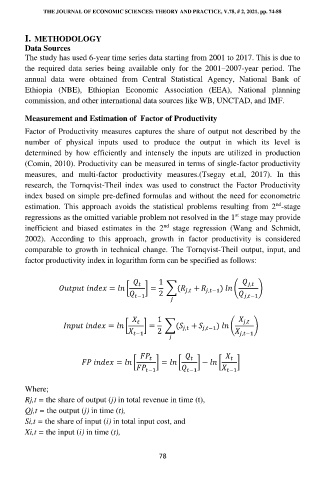
                    comparable to growth in technical change. The Tornqvist-Theil output, input, and
                    factor productivity index in logarithm form can be specified as follows:

                                                           1                             ,
                                                      =      [      ] =  ∑(   +     )      (  )
                                                        −1  2        ,      ,  −1       ,  −1


                                                           1                            ,
                                                     =      [  ] =  ∑(   +      ,  −1 )      (  )
                                                                    ,
                                                       −1  2                           ,  −1


                                                     =      [  ] =      [  ] −      [  ]
                                                            −1         −1          −1

                    Where;
                    Rj,t = the share of output (j) in total revenue in time (t),
                    Qj,t = the output (j) in time (t),
                    Si,t = the share of input (i) in total input cost, and
                    Xi,t = the input (i) in time (t),

                                                           78

