


Page 22 - Azerbaijan State University of Economics
P. 22
Murad Y. Yusıfov: Econometrıc Assessment Of Optımal Interest Burden: Case Study For Azerbaıjan

                    (International Monetary Fund, GFSM, 2014; Xavier and Tidiane, 2013). K.Torstensen


                    defined the interest burden as interest expenses after tax as a percentage of disposable

                    income plus interest expenses after tax. The interest burden impacts the volume of
                    household income which is available for consumption (Kjersti, 2016). According to
                    Guariglia Alessandra, Spaliara Marina-Eliza and Tsoukas Serafeim, a higher interest
                    burden exposes the company to the higher interest costs (Guariglia et al., 2015). The
                    growth of the interest burden affects the level of GDP in the real sector. As a result,
                    the interest expenses debited to the enterprise's expense accounts exerts pressure on
                    the enterprise's net profit, wages and social security contributions and consequently,
                    at the same time it causes the reduction of tax revenues.

                    As a generalized indicator at the macroeconomic level, the interest burden was defined
                    by D.Rodgers as the ratio of accrued interest to GDP. At the enterprise level, the
                    interest  burden  is  defined  as  the  ratio  of  interest  expenses  to  interest  and  pre-tax
                    earnings (EBIT) (David, 2015). Jaroslav Sedlacek and Daniel Nemec determined the
                    company's interest burden as EBT / EBIT (Sedláček & Nemec, 2018).

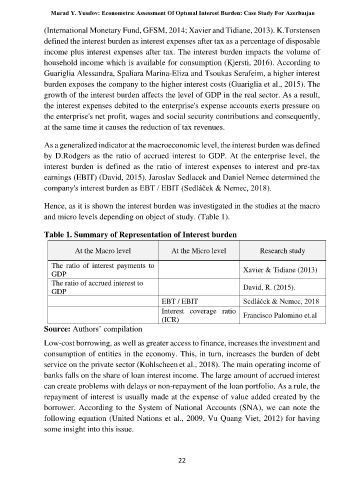
                    Hence, as it is shown the interest burden was investigated in the studies at the macro
                    and micro levels depending on object of study. (Table 1).

                    Table 1. Summary of Representation of Interest burden

                             At the Macro level          At the Micro level         Research study

                      The  ratio  of  interest  payments  to
                      GDP                                                      Xavier & Tidiane (2013)
                      The ratio of accrued interest to                         David, R. (2015).
                      GDP
                                                       EBT / EBIT              Sedláček & Nemec, 2018
                                                       Interest  coverage  ratio
                                                                               Francisco Palomino et.al
                                                       (ICR)
                    Source: Authors’ compilation

                    Low-cost borrowing, as well as greater access to finance, increases the investment and
                    consumption of entities in the economy. This, in turn, increases the burden of debt

                    service on the private sector (Kohlscheen et al., 2018). The main operating income of
                    banks falls on the share of loan interest income. The large amount of accrued interest
                    can create problems with delays or non-repayment of the loan portfolio. As a rule, the
                    repayment of interest is usually made at the expense of value added created by the
                    borrower. According to the System of National Accounts (SNA), we can note the
                    following equation (United Nations et al., 2009, Vu Quang Viet, 2012) for having
                    some insight into this issue.


                                                           22

