


Page 89 - Azerbaijan State University of Economics
P. 89
THE                     JOURNAL OF ECONOMIC SCIENCES: THEORY AND PRACTICE, V.80, # 1, 2023, pp. 83-93

                    In the original  regression, GDP  per  capita is used solely however, in our  model we
                    preferred logarithmic transformation of GDP per capita. There are several reasons for this
                    change. First, as a number GDP per capita is huge compared to other variables so we
                    could not get reasonable coefficient in that way. The second as most importantly, GDP
                    per capita is highly skewed for Azerbaijan since we think high economic growth over the
                    past thirty years, so we need to normalize data. Moreover, change of GDP per capita is
                    more important rather than GDP per capita itself.  Another reason for the logarithmic
                    transformation is to decrease heteroskedasticity (non-constant error term) problem.

                    Moreover,  we  tried  to  add  unemployment  rate  ratio  for  male  to  female  into  our
                    regression  but  in  that  case,  our  explanatory  variables  became  insignificant  there
                    happened multicollinearity problem which might cause bias problem, so we had to
                    drop unemployment ratio variable.

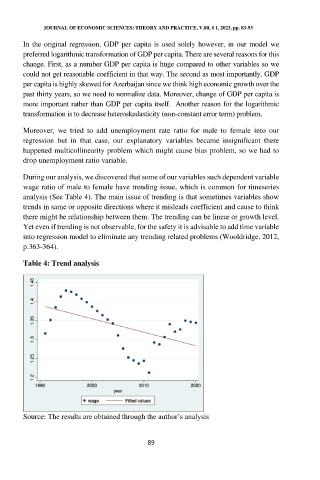
                    During our analysis, we discovered that some of our variables such dependent variable
                    wage ratio of male to female have trending issue, which is common for timeseries
                    analysis (See Table 4). The main issue of trending is that sometimes variables show
                    trends in same or opposite directions where it misleads coefficient and cause to think
                    there might be relationship between them. The trending can be linear or growth level.
                    Yet even if trending is not observable, for the safety it is advisable to add time variable
                    into regression model to eliminate any trending related problems (Wooldridge, 2012,
                    p.363-364).

                    Table 4: Trend analysis


                    Source: The results are obtained through the author’s analysis


                                                           89

