


Page 35 - Azerbaijan State University of Economics
P. 35
Konstantia Darvidou, Evangelos Siskos: Efficiency of International Tourism Marketing
                             for The Promotion of Tourist Products of Greek Companies in The European Market

                    ET = -12.3 + 0.97EG+0.32WB
                              (-1.4)     (4.0)*** (2.4)**

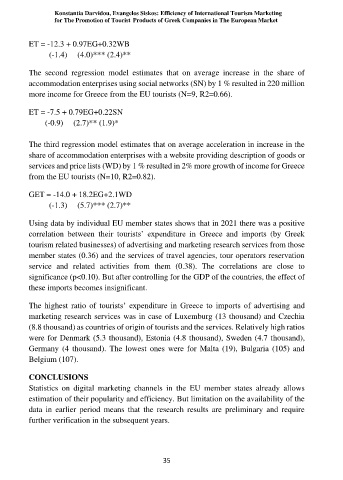
                    The  second  regression  model  estimates  that  on  average  increase  in  the  share  of
                    accommodation enterprises using social networks (SN) by 1 % resulted in 220 million
                    more income for Greece from the EU tourists (N=9, R2=0.66).

                    ET = -7.5 + 0.79EG+0.22SN
                            (-0.9)     (2.7)** (1.9)*

                    The third regression model estimates that on average acceleration in increase in the
                    share of accommodation enterprises with a website providing description of goods or
                    services and price lists (WD) by 1 % resulted in 2% more growth of income for Greece
                    from the EU tourists (N=10, R2=0.82).

                    GET = -14.0 + 18.2EG+2.1WD
                              (-1.3)     (5.7)*** (2.7)**

                    Using data by individual EU member states shows that in 2021 there was a positive
                    correlation  between  their  tourists’  expenditure  in  Greece  and  imports  (by  Greek
                    tourism related businesses) of advertising and marketing research services from those
                    member states (0.36) and the services of travel agencies, tour operators reservation
                    service  and  related  activities  from  them  (0.38).  The  correlations  are  close  to
                    significance (p<0.10). But after controlling for the GDP of the countries, the effect of
                    these imports becomes insignificant.

                    The highest ratio of  tourists’ expenditure in  Greece to  imports of  advertising and
                    marketing research services was in case of Luxemburg (13 thousand) and Czechia
                    (8.8 thousand) as countries of origin of tourists and the services. Relatively high ratios
                    were for Denmark (5.3 thousand), Estonia (4.8 thousand), Sweden (4.7 thousand),
                    Germany  (4  thousand).  The  lowest  ones  were  for  Malta  (19),  Bulgaria  (105)  and
                    Belgium (107).

                    CONCLUSIONS
                    Statistics  on  digital  marketing  channels  in  the  EU  member  states  already  allows
                    estimation of their popularity and efficiency. But limitation on the availability of the
                    data  in  earlier  period  means  that  the  research  results  are  preliminary  and  require
                    further verification in the subsequent years.


                                                           35

