


Page 8 - Azerbaijan State University of Economics
P. 8
THE                      JOURNAL OF ECONOMIC SCIENCES: THEORY AND PRACTICE, V.81, # 1, 2024, pp. 4-21

                    In the period from 1990 to 1994, the flow was almost nonexistent due to the political
                    tensions experienced by the country at that time, which were accompanied by poor
                    economic performance and deterioration of the security situation despite the economic
                    reforms  undertaken  by  the  Algerian  state.  With  Algeria's  structural  adjustment
                    agreement with the International Monetary Fund in 1995, FDI rose to 270 million
                    USD  in  1996.  The  flows  recorded  fluctuating  values  until  the  year  2001,  which
                    exceeded the billion-dollar mark due to the improvement in the country's political
                    situation and the amendments to the investment law to provide a suitable climate to
                    encourage investors through Order 01-03, accompanied by an increase in hydrocarbon
                    revenues and accumulation of foreign exchange reserves. This, in turn, had a positive
                    impact on FDI flows, reaching 2.75 billion USD in 2009.

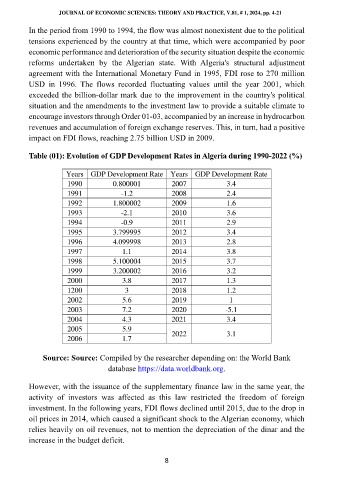
                    Table (01): Evolution of GDP Development Rates in Algeria during 1990-2022 (%)

                               Years  GDP Development Rate  Years  GDP Development Rate
                               1990          0.800001         2007            3.4
                               1991            -1.2           2008            2.4
                               1992          1.800002         2009            1.6
                               1993            -2.1           2010            3.6
                               1994            -0.9           2011            2.9
                               1995          3.799995         2012            3.4
                               1996          4.099998         2013            2.8
                               1997            1.1            2014            3.8
                               1998          5.100004         2015            3.7
                               1999          3.200002         2016            3.2
                               2000            3.8            2017            1.3
                               1200             3             2018            1.2
                               2002            5.6            2019             1
                               2003            7.2            2020            -5.1
                               2004            4.3            2021            3.4
                               2005            5.9            2022            3.1
                               2006            1.7

                        Source: Source: Compiled by the researcher depending on: the World Bank
                                           database https://data.worldbank.org.

                    However, with the issuance of the supplementary finance law in the same year, the
                    activity  of  investors  was  affected  as  this  law  restricted  the  freedom  of  foreign
                    investment. In the following years, FDI flows declined until 2015, due to the drop in
                    oil prices in 2014, which caused a significant shock to the Algerian economy, which
                    relies heavily on oil revenues, not to mention the depreciation of the dinar and the
                    increase in the budget deficit.


                                                            8

