


Page 65 - Azerbaijan State University of Economics
P. 65
Abderrahmane Benouaret: Towards Regulating Freelance Work and the Informal
                             Economy in Algeria: Will the Self-Employed Contractor Law Suffice?


                     All  they  need  is  a  computer  or  smart  phone  with  internet  access,  an  email  for
                    communication, and an electronic payment tool  (Akhmetshin, Kovalenko, Mueller,
                    Khakimov, Yumashev, & Khairullina, 2018).

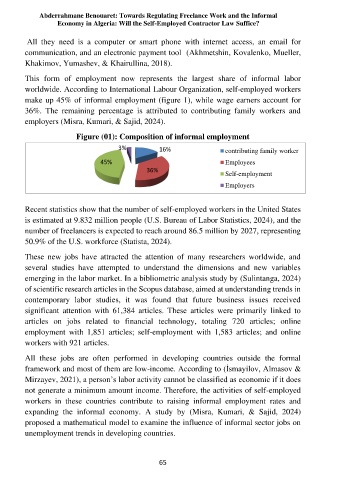
                    This  form  of  employment  now  represents  the  largest  share  of  informal  labor
                    worldwide. According to International Labour Organization, self-employed workers
                    make up 45% of informal employment (figure 1), while wage earners account for
                    36%.  The  remaining  percentage  is  attributed  to  contributing  family  workers  and
                    employers (Misra, Kumari, & Sajid, 2024).

                                   Figure (01): Composition of informal employment

                                               3%          16%                 contributing family worker
                                          45%                                  Employees
                                                        36%
                                                                               Self-employment
                                                                               Employers


                    Recent statistics show that the number of self-employed workers in the United States
                    is estimated at 9.832 million people (U.S. Bureau of Labor Statistics, 2024), and the
                    number of freelancers is expected to reach around 86.5 million by 2027, representing
                    50.9% of the U.S. workforce (Statista, 2024).

                    These  new  jobs  have  attracted  the  attention  of  many  researchers  worldwide,  and
                    several  studies  have  attempted  to  understand  the  dimensions  and  new  variables
                    emerging in the labor market. In a bibliometric analysis study by (Sulintanga, 2024)
                    of scientific research articles in the Scopus database, aimed at understanding trends in
                    contemporary  labor  studies,  it  was  found  that  future  business  issues  received
                    significant  attention  with  61,384  articles.  These  articles  were  primarily  linked  to
                    articles  on  jobs  related  to  financial  technology,  totaling  720  articles;  online
                    employment  with  1,851  articles;  self-employment  with  1,583  articles;  and  online
                    workers with 921 articles.

                    All  these  jobs  are  often  performed  in  developing  countries  outside  the  formal
                    framework and most of them are low-income. According to (İsmayilov, Almasov &
                    Mirzayev, 2021), a person’s labor activity cannot be classified as economic if it does
                    not generate a minimum amount income. Therefore, the activities of self-employed
                    workers  in  these  countries  contribute  to  raising  informal  employment  rates  and
                    expanding  the  informal  economy.  A  study  by  (Misra,  Kumari,  &  Sajid,  2024)
                    proposed a mathematical model to examine the influence of informal sector jobs on
                    unemployment trends in developing countries.


                                                           65

