


Page 103 - Azerbaijan State University of Economics
P. 103
Nazim Hajiyev, Daniyar Aliyev: A DSGE Framework For Sovereign Digital Currency
                         Adoption in Small Open Economies: Macro-Financial Channels, Bank Intermediation, and
                         Policy Trade-Offs


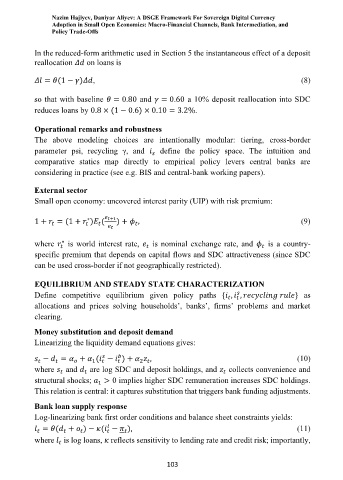
                    In the reduced-form arithmetic used in Section 5 the instantaneous effect of a deposit
                    reallocation      on loans is

                         =   (1 −   )    ,                                                                                                                      (8)


                    so that with baseline    = 0.80 and    = 0.60 a 10% deposit reallocation into SDC
                    reduces loans by 0.8 × (1 − 0.6) × 0.10 = 3.2%.


                    Operational remarks and robustness
                    The  above  modeling  choices  are  intentionally  modular:  tiering,  cross-border

                    parameter  psi,  recycling  γ,  and       define  the  policy  space.  The  intuition  and

                    comparative  statics  map  directly  to  empirical  policy  levers  central  banks  are
                    considering in practice (see e.g. BIS and central-bank working papers).

                    External sector
                    Small open economy: uncovered interest parity (UIP) with risk premium:

                                   ∗
                    1 +    = (1 +    )   (      +1 ) +    ,                                                                                              (9)


                            ∗
                    where     is world interest rate,     is nominal exchange rate, and      is a country-


                    specific premium that depends on capital flows and SDC attractiveness (since SDC
                    can be used cross-border if not geographically restricted).
                    EQUILIBRIUM AND STEADY STATE CHARACTERIZATION

                    Define  competitive  equilibrium  given  policy  paths  {   ,    ,                            }  as


                    allocations  and  prices  solving  households’,  banks’,  firms’  problems  and  market
                    clearing.

                    Money substitution and deposit demand
                    Linearizing the liquidity demand equations gives:


                       −    =    +    (   −    ) +       ,                                                                                          (10)

                                                   2
                                     1


                    where     and     are log SDC and deposit holdings, and     collects convenience and


                    structural shocks;    > 0 implies higher SDC remuneration increases SDC holdings.
                                       1
                    This relation is central: it captures substitution that triggers bank funding adjustments.

                    Bank loan supply response
                    Log-linearizing bank first order conditions and balance sheet constraints yields:
                       =   (   +    ) −   (   −    ),                                                                                                 (11)


                    where     is log loans,    reflects sensitivity to lending rate and credit risk; importantly,

                                                           103

