


Page 117 - Azerbaijan State University of Economics
P. 117
THE                      JOURNAL OF ECONOMIC SCIENCES: THEORY AND PRACTICE, V.83, # 1, 2026, pp. 107-131

                    This article focused on the growth of Aritifical intelligence in the financial organizations
                    due to the multiple benefits including cost reduction, operational effieciency and increase
                    differentiation however the also emphazied the potential risk which financial organization
                    need  to  consider  including  biased  data,  algorithm  errors,  excessive  dependence  on
                    automated decision making which needs human oversight and risk management. Further,
                    Shanmuganathan (2020) received the second highest citation count (157). This paper
                    addresses on the recent AI applications including financial advisory services known as
                    robo advising through longitudinal case study. The findings revealed that how robo-
                    advisory  platforms  influence  behavioral  finance  and  investment  decision-making
                    processes by reducing emotional and cognitive biases among retail investors. This study
                    further  concluded  that  robo  advisors  provide  financial  literacy  support  and  impartial
                    expert advice to investors.

                    3.6 Author's Co-Authorship Network Analysis
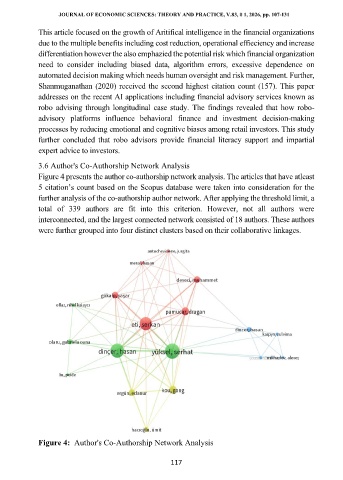
                    Figure 4 presents the author co-authorship network analysis. The articles that have atleast
                    5 citation’s count based on the Scopus database were taken into consideration for the
                    further analysis of the co-authorship author network. After applying the threshold limit, a
                    total  of  339  authors  are  fit  into  this  criterion.  However,  not  all  authors  were
                    interconnected, and the largest connected network consisted of 18 authors. These authors
                    were further grouped into four distinct clusters based on their collaborative linkages.


                    Figure 4:  Author's Co-Authorship Network Analysis


                                                           117

