


Page 17 - Azerbaijan State University of Economics
P. 17
THE JOURNAL OF ECONOMIC SCIENCES: THEORY AND  PRACTICE, V.70,  # 2, 2013,  pp. 4-31


                                                      Monotheist time


                                                  One-side directed cycle


                                                         Regress
                        Past                                                                     Future


                 Non-material  world         Past            Present          Future        Non-material
                 or paradise                                                                world or paradise

                                                     Material or current wold


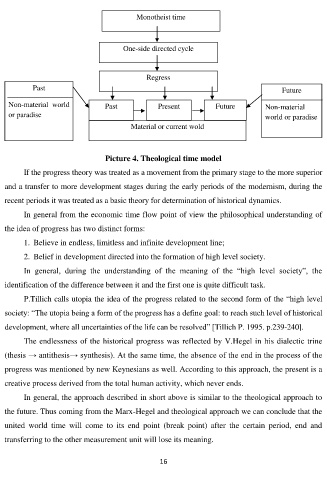
                                             Picture 4. Theological time model

                     If the progress theory was treated as a movement from the primary stage to the more superior
               and a transfer to more development stages during the early periods of the modernism, during the

               recent periods it was treated as a basic theory for determination of historical dynamics.

                     In general from the economic time flow point of view the philosophical understanding of
               the idea of progress has two distinct forms:

                     1.  Believe in endless, limitless and infinite development line;

                     2.  Belief in development directed into the formation of high level society.
                     In  general,  during  the  understanding  of  the  meaning  of  the  “high  level  society”,  the

               identification of the difference between it and the first one is quite difficult task.
                     P.Tillich calls utopia the idea of the progress related to the second form of the “high level

               society: “The utopia being a form of the progress has a define goal: to reach such level of historical
               development, where all uncertainties of the life can be resolved” [Tillich P. 1995. p.239-240].

                     The endlessness of the historical progress was reflected by V.Hegel in his dialectic trine

               (thesis → antithesis→ synthesis). At the same time, the absence of the end in the process of the
               progress was mentioned by new Keynesians as well. According to this approach, the present is a

               creative process derived from the total human activity, which never ends.
                     In general, the approach described in short above is similar to the theological approach to

               the future. Thus coming from the Marx-Hegel and theological approach we can conclude that the
               united  world  time  will  come  to  its  end  point  (break  point)  after  the  certain  period,  end  and

               transferring to the other measurement unit will lose its meaning.


                                                             16

