


Page 19 - Azerbaijan State University of Economics
P. 19
THE JOURNAL OF ECONOMIC SCIENCES: THEORY AND  PRACTICE, V.70,  # 2, 2013,  pp. 4-31


               modernism  period  developed  in  70-80s  of  XX  century.  Although  some  portion  of  modern

               approached  is  widely  accepted,  points  related  to  the  time  understanding  were  conceptually
               changed.  The  time  already  accepted  the  completeness  feature.  In  postmodernism  the  time  is

               revocable and repeating – unlike in traditional society – we talk about “postmodernism repeat”.

                     The existence of time flows like past    present    future and wise versa are treated from
               discrete point of view.

                     The suspicion created by the some features of the modernist model resulted in “multitude”
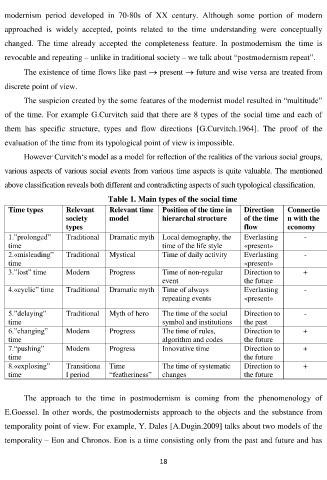
               of the time. For example G.Curvitch said that there are 8 types of the social time and each of

               them  has  specific  structure,  types  and  flow  directions  [G.Curvitch.1964].  The  proof  of  the
               evaluation of the time from its typological point of view is impossible.

                     However Curvitch‘s model as a model for reflection of the realities of the various social groups,

               various aspects of various social events from various time aspects is quite valuable. The mentioned
               above classification reveals both different and contradicting aspects of such typological classification.

                                              Table 1. Main types of the social time
                Time types       Relevant     Relevant time  Position of the time in   Direction   Connectio
                                 society      model           hierarchal structure    of the time  n with the
                                 types                                                flow         economy
                1.”prolonged”    Traditional   Dramatic myth  Local demography, the   Everlasting       -
                time                                          time of the life style    «present»
                2.«misleading”   Traditional   Mystical       Time of daily activity   Everlasting      -
                time                                                                  «present»
                3.”lost” time    Modern       Progress        Time of non-regular     Direction to     +
                                                              event                   the future
                4.«cyclic” time   Traditional   Dramatic myth  Time of always         Everlasting       -
                                                              repeating events        «present»

                5.”delaying”     Traditional   Myth of hero   The time of the social   Direction to     -
                time                                          symbol and institutions   the past
                6.”changing”     Modern       Progress        The time of rules,      Direction to     +
                time                                          algorithm and codes     the future
                7.“pushing”      Modern       Progress        Innovative time         Direction to     +
                time                                                                  the future
                8.«explosing”    Transitiona  Time            The time of systematic   Direction to    +
                time             l period     “featheriness”   changes                the future


                     The  approach  to  the  time  in  postmodernism  is  coming  from  the  phenomenology  of
               E.Goessel. In other words, the postmodernists approach to the objects and the substance from

               temporality point of view. For example, Y. Dales [A.Dugin.2009] talks about two models of the
               temporality – Eon and Chronos. Eon is a time consisting only from the past and future and has


                                                             18

