


Page 69 - Azerbaijan State University of Economics
P. 69
A.Rozhko, H.Wiesmeth: Framework conditions for using renewable energy sources:
                                                                 Quo Vadis, Ukraine?

               environmentally  friendly  technologies  (for  further  details  on  the  German  «energy  transition»

               (Energiewende) see Wiesmeth (2011a)).
                     Similarly, in its 7th Environment Action Programme adopted by  the EU Commission in

               late  November  2012,  the  European  Union  (EU)  wants  to  fully  implement  the  «climate  and
               energy package» by 2020. According to the «20-20-20» aim, by 2020 the EU's greenhouse gas

               emissions should be reduced by 20% compared to 1990, the share of renewable energies in EU
               energy consumption should increase by 20%, and, in addition, the energy efficiency in the EU

               should  rise  by  20%.  It  is  expected  that  these  objectives  will  contribute  to  the  mitigation  of

               climate  change  and  to  the  security  of  energy  supply  in  the  EU.  The  anticipated  increasing
               international  competitiveness  of  European  enterprises  in  environmental  technologies  will  thus

               stimulate «green growth» (see EU (2012)).

                     These are ambitious goals that will be accessible only by concrete measures and supportive
               framework  conditions.  In  Germany  there  is  for  example  the  «Renewable  Energy  Sources  Act»

               (Erneuerbaren-  Energien-Gesetz  –  EEG)  with  its  guaranteed  feed-in-tariffs  (see  Deutschland
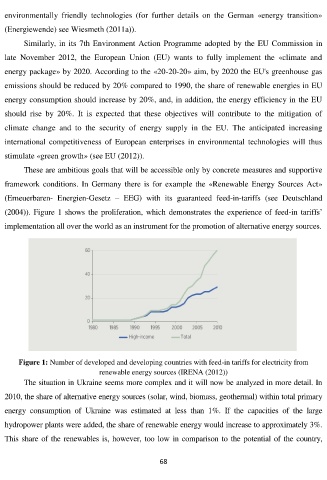
               (2004)). Figure 1 shows the proliferation, which demonstrates the experience of feed-in tariffs’

               implementation all over the world as an instrument for the promotion of alternative energy sources.


                    Figure 1: Number of developed and developing countries with feed-in tariffs for electricity from
                                           renewable energy sources (IRENA (2012))
                     The situation in Ukraine seems more complex and it will now be analyzed in more detail. In
               2010, the share of alternative energy sources (solar, wind, biomass, geothermal) within total primary

               energy  consumption  of  Ukraine  was  estimated  at  less  than  1%.  If  the  capacities  of  the  large
               hydropower plants were added, the share of renewable energy would increase to approximately 3%.

               This share of the renewables is, however, too low in comparison to the potential of the country,


                                                             68

