


Page 70 - Azerbaijan State University of Economics
P. 70
THE JOURNAL OF ECONOMIC SCIENCES: THEORY AND PRACTICE, V.70,  # 2, 2013,  pp. 67-79


               especially in view of the available biomass exploitable for energy purposes. Obviously, the current

               framework conditions do not encourage a more active use of alternative energy sources.
                     2. Energetics and Energy Policy in Ukraine

                     2.1. General Overview
                     Similarly to most other European countries, Ukraine is dependent on energy imports. Annual

               energy consumption (currently 190 to 200 MTCE (Mega Tonnes of Coal Equivalent)) is satisfied
               only at 43 to 45% using its own resources. In 2011, approximately 50% (about 182.6 MTCE) of the

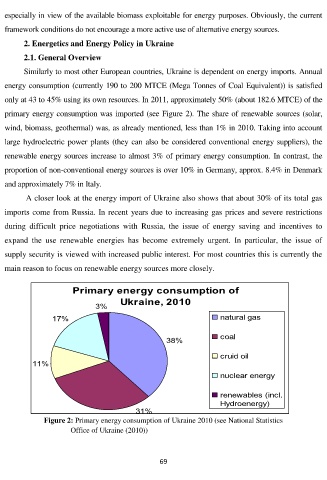
               primary energy consumption was imported (see Figure 2). The share of renewable sources (solar,

               wind, biomass, geothermal) was, as already mentioned, less than 1% in 2010. Taking into account
               large hydroelectric power plants (they can also be considered conventional energy suppliers), the

               renewable energy sources increase to almost 3% of primary energy consumption. In contrast, the

               proportion of non-conventional energy sources is over 10% in Germany, approx. 8.4% in Denmark
               and approximately 7% in Italy.

                      A closer look at the energy import of Ukraine also shows that about 30% of its total gas
               imports come from Russia. In recent years due to increasing gas prices and severe restrictions

               during  difficult  price  negotiations  with  Russia,  the  issue  of  energy  saving  and  incentives  to
               expand  the  use  renewable  energies  has  become  extremely  urgent.  In  particular,  the  issue  of

               supply security is viewed with increased public interest. For most countries this is currently the

               main reason to focus on renewable energy sources more closely.


                                   Primary energy consumption of
                                                 Ukraine, 2010
                                          3%
                             17%                                               natural gas

                                                                               coal
                                                               38%

                                                                               cruid oil
                        11%

                                                                               nuclear energy

                                                                               renewables (incl.
                                                                               Hydroenergy)
                                                      31%
                           Figure 2: Primary energy consumption of Ukraine 2010 (see National Statistics
                                              Office of Ukraine (2010))


                                                             69

