


Page 133 - Azerbaijan State University of Economics
P. 133
THE JOURNAL OF ECONOMIC SCIENCES: THEORY AND  PRACTICE, V.71,  # 1, 2014,  pp. 127-139


                     In a first step the different data sources were identified and structured in a central repository.


               Normally – as in this case - there are 5 different kinds of data being integrated in the dataset:

                     (1) Costdata from common cost tables on wages, (2) treatmentcost and cost of equipment,

               (3)  Data  on Process Work-flows mostly from specific studies (e.g. How long does it  take to


               perform an ECG?), (4) Data on population epidemiology like incidence and prevalence rates for

               targeted illnesses, and last (5) Data on specific effects of the Technology to be investigated in the

               simulation.In a second step the data is “normalized”: All input and outcome values are projected


               to  a similar “normalized” set  of parameters.  This normalisation process  would for  example

               project different studies comparing the impact of a HF-Monitoring system to the two parameters


               “Number of Hospitalisations” and “Length of Stay” with and without the technology and would

               make it compareable to other studies dealing with a compareable technology.

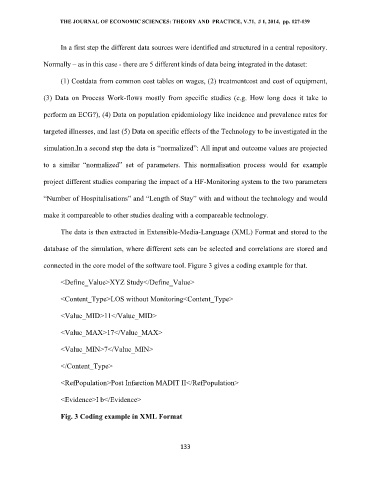
                     The data is then extracted in Extensible-Media-Language (XML) Format and stored to the


               database of the simulation, where different sets can be selected and correlations are stored and

               connected in the core model of the software tool. Figure 3 gives a coding example for that.

                     <Define_Value>XYZ Study</Define_Value>


                     <Content_Type>LOS without Monitoring<Content_Type>

                     <Value_MID>11</Value_MID>

                     <Value_MAX>17</Value_MAX>


                     <Value_MIN>7</Value_MIN>

                     </Content_Type>

                     <RefPopulation>Post Infarction MADIT II</RefPopulation>


                     <Evidence>I b</Evidence>

                     Fig. 3 Coding example in XML Format


                                                           133

