


Page 66 - Azerbaijan State University of Economics
P. 66
THE JOURNAL OF ECONOMIC SCIENCES: THEORY AND PRACTICE, V.72,  # 2, 2015, pp. 54-72


                         The  proposed  technique  for  a  complex  evaluation  of  an  innovative  potential,
                    constructed  with  the  use  of  the  theory  of  fuzzy  sets,  was  not  previously  applied  to
                    evaluation  of  an  innovative  potential  for  a  factorial  analysis  of  the  social  and
                    economic environment of the scientific-technological complex of the economic zones.
                         Implementation of the given method envisages several stages:
                         -Parametrical values from the corresponding groups of factors are calculated;
                         - Fuzzification is done – transformation of the design indicators into the values
                    of linguistic variables with the use of the membership functions. For this purpose
                    definitions of the linguistic variables and fuzzy subsets for each element are entered.
                    Belonging  of  each  accurate  value  to  one  of  the  terms  of  a  linguistic  variable  is
                    determined by means of a membership function.
                         Also possible is the use of the arbitrary and standard membership functions;
                         -  At  the  stage  of  development  of  the  fuzzy  rules,  the  productional  rules,
                    connecting two linguistic variables, are defined. A set of such rules describes the
                    management strategy applied for evaluation of an innovative potential;
                         - At the defuzzification stage generalization is done of the data concerning the
                    level  of  an  innovative  potential  into  an  integrated  indicator  with  account  of  the
                    weighting coefficients of the influencing factors.
                         For evaluation of the level of an innovative potential two linguistic variables
                    are  set.  The  first  variable  with  the  corresponding  terms-subsets  is  introduced  for
                    evaluation  of  each  concrete  model  element.  Evaluation  of  each  indicator  is  done
                    according to the standard 3-level scale, where linguistic descriptions: low, medium
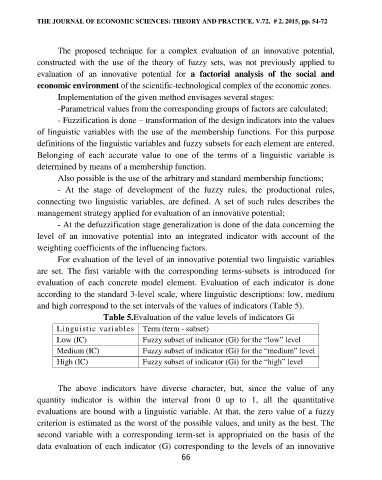
                    and high correspond to the set intervals of the values of indicators (Table 5).
                                      Table 5.Evaluation of the value levels of indicators Gi
                         Linguistic variables  Term (term - subset)
                         Low (IC)                Fuzzy subset of indicator (Gi) for the “low” level
                         Medium (IC)             Fuzzy subset of indicator (Gi) for the “medium” level
                         High (IC)               Fuzzy subset of indicator (Gi) for the “high” level


                         The  above  indicators  have  diverse  character,  but,  since  the  value  of  any
                    quantity  indicator  is  within  the  interval  from  0  up  to  1,  all  the  quantitative
                    evaluations are bound with a linguistic variable. At that, the zero value of a fuzzy
                    criterion is estimated as the worst of the possible values, and unity as the best. The
                    second variable with  a  corresponding term-set  is appropriated on the basis of the
                    data evaluation of each indicator (G) corresponding to the levels of an innovative
                                                           66

