


Page 17 - Azerbaijan State University of Economics
P. 17
N.Akimov., S.Baizakov., A. Oinarov., E.Utembayev: The analysis of the macroeconomic
                                                 dynamics and assessment of smart factors’ inputs to the balanced growth rates


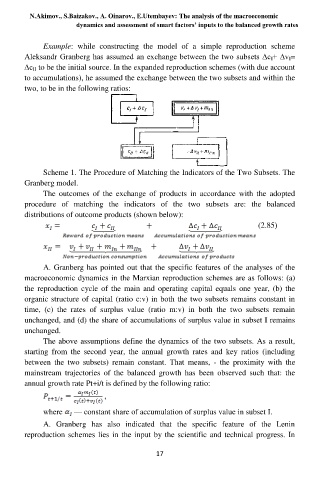
                         Example:  while  constructing  the  model  of  a  simple  reproduction  scheme
                    Aleksandr Granberg has assumed an exchange between the two subsets ∆c I+ ∆v I=
                    ∆c II to be the initial source. In the expanded reproduction schemes (with due account
                    to accumulations), he assumed the exchange between the two subsets and within the
                    two, to be in the following ratios:


                         Scheme 1. The Procedure of Matching the Indicators of the Two Subsets. The
                    Granberg model.
                         The  outcomes  of  the  exchange  of  products  in  accordance  with  the  adopted
                    procedure  of  matching  the  indicators  of  the  two  subsets  are:  the  balanced
                    distributions of outcome products (shown below):
                                                                                           (2.85)


                         A. Granberg has pointed out that the specific features of the analyses of the
                    macroeconomic dynamics in the Marxian reproduction schemes are as follows: (a)
                    the  reproduction  cycle  of  the  main  and  operating  capital  equals  one  year,  (b)  the
                    organic structure of capital (ratio c:v) in both the two subsets remains constant in
                    time,  (c)  the  rates  of  surplus  value  (ratio  m:v)  in  both  the  two  subsets  remain
                    unchanged, and (d) the share of accumulations of surplus value in subset I remains
                    unchanged.
                         The above assumptions define the dynamics of the two subsets. As a result,
                    starting  from  the  second  year,  the  annual  growth  rates  and  key  ratios  (including
                    between  the  two  subsets)  remain  constant.  That  means,  -  the  proximity  with  the
                    mainstream  trajectories  of  the  balanced  growth  has  been  observed  such  that:  the
                    annual growth rate Pt+i/t is defined by the following ratio:

                                            ,

                         where   — constant share of accumulation of surplus value in subset I.
                         A.  Granberg  has  also  indicated  that  the  specific  feature  of  the  Lenin
                    reproduction schemes lies in the input by the scientific and technical progress.  In


                                                           17

