


Page 21 - Azerbaijan State University of Economics
P. 21
N.Akimov., S.Baizakov., A. Oinarov., E.Utembayev: The analysis of the macroeconomic
                                                dynamics and assessment of smart factors’ inputs to the balanced growth rates

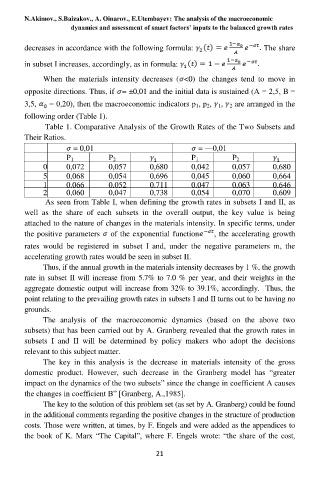
                    decreases in accordance with the following formula:                     The share

                    in subset I increases, accordingly, as in formula:

                         When  the  materials  intensity  decreases  ( <0)  the  changes  tend  to  move  in
                    opposite directions. Thus, if  = ±0,01 and the initial data is sustained (А = 2,5, В =

                    3,5,    = 0,20), then the macroeconomic indicators р 1, р 2,  1,  2 are arranged in the
                    following order (Table 1).
                          Table 1. Comparative Analysis of the Growth Rates of the Two Subsets and
                    Their Ratios.
                                   = 0,01                                = —0,01
                                P 1          P 2                      P 1         P 2
                         0      0,072        0,057        0,680       0,042       0,057        0,680
                         5      0,068        0,054        0,696       0,045       0,060        0,664
                         1      0,066        0,052        0,711       0,047       0,063        0,646
                    0    2      0,060        0,047        0,738       0,054       0,070        0,609
                    0     As seen from Table I, when defining the growth rates in subsets I and II, as
                    well  as  the  share  of  each  subsets  in  the  overall  output,  the  key  value  is  being
                    attached to the nature of changes in the materials intensity. In specific terms, under
                    the positive parameters   of the exponential function    , the accelerating growth

                    rates  would  be  registered  in  subset  I  and,  under  the  negative  parameters  m,  the
                    accelerating growth rates would be seen in subset II.
                         Thus, if the annual growth in the materials intensity decreases by 1 %, the growth
                    rate in subset II will increase from 5.7% to 7.0 % per year, and their weights in the
                    aggregate domestic output will increase from 32% to 39.1%, accordingly.  Thus, the
                    point relating to the prevailing growth rates in subsets I and II turns out to be having no
                    grounds.
                         The  analysis  of  the  macroeconomic  dynamics  (based  on  the  above  two
                    subsets) that has been carried out by A. Granberg revealed that the growth rates in
                    subsets  I  and  II  will  be  determined  by  policy  makers  who  adopt  the  decisions
                    relevant to this subject matter.
                         The  key  in  this  analysis  is  the  decrease  in  materials  intensity  of  the  gross
                    domestic  product.  However,  such  decrease  in  the  Granberg  model  has  ―greater
                    impact on the dynamics of the two subsets‖ since the change in coefficient A causes
                    the changes in coefficient B‖ [Granberg, A.,1985].
                         The key to the solution of this problem set (as set by A. Granberg) could be found
                    in the additional comments regarding the positive changes in the structure of production
                    costs. Those were written, at times, by F. Engels and were added as the appendices to
                    the  book  of  K.  Marx  ―The  Capital‖,  where  F.  Engels  wrote:  ―the  share  of  the  cost,


                                                           21

