


Page 56 - Azerbaijan State University of Economics
P. 56
THE JOURNAL OF ECONOMIC SCIENCES: THEORY AND PRACTICE, V.76, # 1, 2019, pp. 48-69


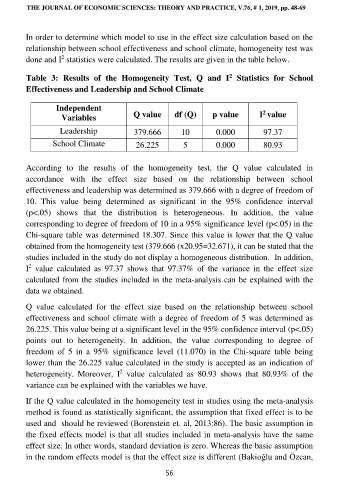
                    In order to determine which model to use in the effect size calculation based on the
                    relationship between school effectiveness and school climate, homogeneity test was
                              2
                    done and I  statistics were calculated. The results are given in the table below.
                    Table  3:  Results  of  the  Homogeneity  Test,  Q  and  I   Statistics  for  School
                                                                              2
                    Effectiveness and Leadership and School Climate

                            Independent                                                2
                              Variables           Q value     df (Q)     p value      I value

                             Leadership           379.666       10        0.000        97.37

                           School Climate          26.225       5         0.000        80.93


                    According  to     the  results  of  the  homogeneity  test,  the  Q  value  calculated  in
                      /////VvVariablesVariable
                    accordance  with  the  effect  size  based  on  the  relationship  between  school
                    effectiveness and leadership was determined as 379.666 with a degree of freedom of
                    10.  This  value  being  determined  as  significant  in  the  95%  confidence  interval
                    (p<.05)  shows  that  the  distribution  is  heterogeneous.  In  addition,  the  value
                    corresponding to degree of freedom of 10 in a 95% significance level (p<.05) in the
                    Chi-square table was determined 18.307. Since this value is lower that the Q value
                    obtained from the homogeneity test (379.666 (x20.95=32.671), it can be stated that the
                    studies included in the study do not display a homogeneous distribution.  In addition,
                    2
                    I   value  calculated  as  97.37  shows  that  97.37%  of  the  variance  in  the  effect  size
                    calculated from the studies included in the meta-analysis can be explained with the
                    data we obtained.

                    Q  value  calculated  for  the  effect  size  based  on  the  relationship  between  school
                    effectiveness and school climate with a degree of freedom of 5 was determined as
                    26.225. This value being at a significant level in the 95% confidence interval (p<.05)
                    points  out  to  heterogeneity.  In  addition,  the  value  corresponding  to  degree  of
                    freedom  of  5  in  a  95%  significance  level  (11.070)  in  the  Chi-square  table  being
                    lower than the 26.225 value calculated in the study is accepted as an indication of
                                              2
                    heterogeneity.  Moreover,  I   value  calculated  as  80.93  shows  that  80.93%  of  the
                    variance can be explained with the variables we have.

                    If the Q value calculated in the homogeneity test in studies using the meta-analysis
                    method is found as statistically significant, the assumption that fixed effect is to be
                    used and  should be reviewed (Borenstein et. al, 2013:86). The basic assumption in
                    the fixed effects model is that all studies included in meta-analysis have the same
                    effect size. In other words, standard deviation is zero. Whereas the basic assumption
                    in the random effects model is that the effect size is different (Bakioğlu and Özcan,

                                                           56

