


Page 17 - Azerbaijan State University of Economics
P. 17
Gorkhmaz Imanov, Asif Aliyev : Fuzzy Linguistic Forecasting of Social Mobility


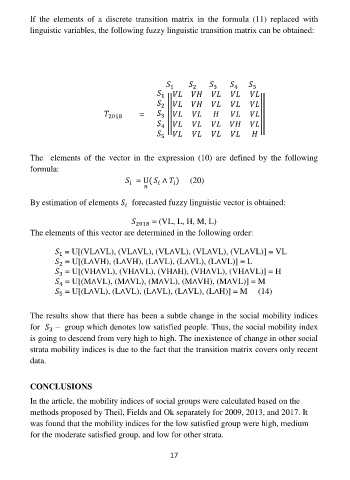
                    If  the  elements  of  a  discrete  transition  matrix  in  the  formula  (11)  replaced  with
                    linguistic variables, the following fuzzy linguistic transition matrix can be obtained:


                                                                              4
                                                                                   5
                                                                        3
                                                           1
                                                                  2


                                                         1

                                                           2
                                                           ‖
                                                                                     ‖
                                                2018         =
                                                 Место для уравнения.
                                                                                     ‖
                                                           ‖
                                                         3
                                                           4
                                                           5


                    The    elements  of  the  vector  in  the  expression  (10)  are  defined  by  the  following
                    formula:
                                                                      = U(    ∧    )     (20)


                    By estimation of elements      forecasted fuzzy linguistic vector is obtained:


                                                   2018  = (VL, L, H, M, L)
                    The elements of this vector are determined in the following order:

                               = U[(VL∧VL), (VL∧VL), (VL∧VL), (VL∧VL), (VL∧VL)] = VL
                            1
                               = U[(L∧VH), (L∧VH), (L∧VL), (L∧VL), (L∧VL)] = L
                            2
                               = U[(VH∧VL), (VH∧VL), (VH∧H), (VH∧VL), (VH∧VL)] = H
                            3
                               = U[(M∧VL), (M∧VL), (M∧VL), (M∧VH), (M∧VL)] = M
                            4
                               = U[(L∧VL), (L∧VL), (L∧VL), (L∧VL), (L∧H)] = M     (14)
                            5

                    The results show that there has been a subtle change in the social mobility indices
                    for      –  group which denotes low satisfied people. Thus, the social mobility index
                         3
                    is going to descend from very high to high. The inexistence of change in other social
                    strata mobility indices is due to the fact that the transition matrix covers only recent
                    data.

                    CONCLUSIONS
                    In the article, the mobility indices of social groups were calculated based on the
                    methods proposed by Theil, Fields and Ok separately for 2009, 2013, and 2017. It
                    was found that the mobility indices for the low satisfied group were high, medium
                    for the moderate satisfied group, and low for other strata.


                                                           17

