


Page 16 - Azerbaijan State University of Economics
P. 16
THE JOURNAL OF ECONOMIC SCIENCES: THEORY AND PRACTICE, V.76, # 2, 2019, pp. 4-20


                                                                3
                                                                       4
                                                    1
                                                                              5
                                                          2
                                                1 0    1     0     0      0

                                                2 0    1     0     0      0
                                                ‖
                                         2017  =           0  0.04 0.9 0.06  0  ‖
                                                ‖
                                                                             ‖
                                              3
                                                4 0    0     0     1      0
                                                5 0    0     0    0.08 0.92

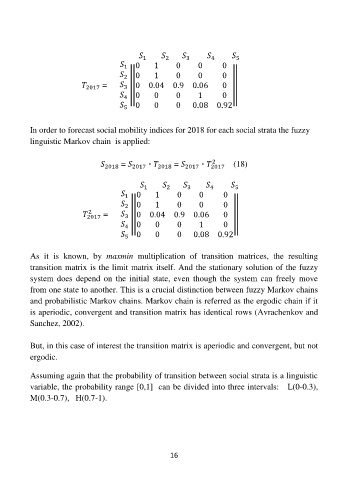
                    In order to forecast social mobility indices for 2018 for each social strata the fuzzy
                    linguistic Markov chain  is applied:

                                                                       2
                                           2018  =    2017  ◦    2018  =    2017  ◦    2017     (18)

                                                                           2
                                                                              5
                                                                3
                                                                       4
                                                    1
                                                1 0    1       0    0      0
                                                2 0    1       0    0      0
                                                ‖

                                    2
                                      2017  =           0  0.04 0.9 0.06   0  ‖
                                                ‖
                                               3
                                                                             ‖
                                                4 0    0     0      1      0
                                                5 0    0     0    0.08 0.92


                    As  it  is  known,  by  maxmin  multiplication  of  transition  matrices,  the  resulting

                    transition matrix is the limit matrix itself. And the stationary solution of the fuzzy
                    system  does  depend  on  the  initial  state,  even  though  the  system  can  freely  move
                    from one state to another. This is a crucial distinction between fuzzy Markov chains
                    and probabilistic Markov chains. Markov chain is referred as the ergodic chain if it
                    is aperiodic, convergent and transition matrix has identical rows (Avrachenkov and
                    Sanchez, 2002).

                    But, in this case of interest the transition matrix is aperiodic and convergent, but not
                    ergodic.

                    Assuming again that the probability of transition between social strata is a linguistic
                    variable, the probability range [0,1]  can be divided into three intervals:   L(0-0.3),
                    M(0.3-0.7),   H(0.7-1).


                                                           16

