


Page 11 - Azerbaijan State University of Economics
P. 11
Gorkhmaz Imanov, Asif Aliyev : Fuzzy Linguistic Forecasting of Social Mobility


                    21   240.1-280.0   0.021   300- more    0.052    450,1-500,0    0.019
                    22    280 – more   0.03       -          -       500,1-550,0    0.011
                    23        -         -         -          -        550-more      0.018
                    www.azstat.gov.az
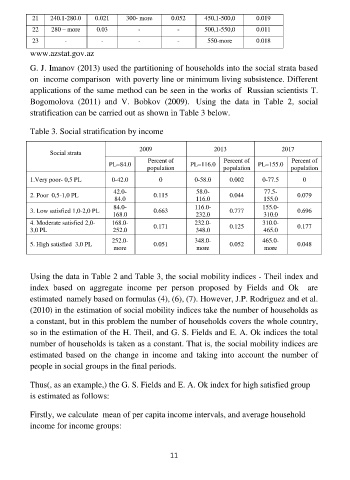
                    G. J. Imanov (2013) used the partitioning of households into the social strata based
                    on  income comparison  with poverty line or minimum living subsistence. Different
                    applications of the same method can be seen in the works of  Russian scientists T.
                    Bogomolova  (2011)  and  V.  Bobkov  (2009).   Using  the  data  in  Table  2,  social
                    stratification can be carried out as shown in Table 3 below.

                    Table 3. Social stratification by income

                                                   2009                 2013               2017
                         Social strata
                                                     Percent of            Percent of         Percent of
                                          PL=84.0                PL=116.0           PL=155.0
                                                     population           population          population
                    1.Very poor- 0,5 PL    0-42.0       0         0-58.0    0.002     0-77.5     0

                                           42.0-                   58.0-              77.5-
                    2. Poor  0,5-1,0 PL                0.115                0.044               0.079
                                            84.0                   116.0              155.0
                                           84.0-                  116.0-              155.0-
                    3. Low satisfied 1,0-2,0 PL        0.663                0.777               0.696
                                           168.0                   232.0              310.0
                    4. Moderate satisfied 2,0-  168.0-  0.171     232.0-    0.125     310.0-    0.177
                    3,0 PL                 252.0                   348.0              465.0
                                           252.0-                 348.0-              465.0-
                    5. High satisfied  3,0 PL          0.051                0.052               0.048
                                           more                    more               more


                    Using the data in Table 2 and Table 3, the social mobility indices - Theil index and
                    index  based  on  aggregate  income  per  person  proposed  by  Fields  and  Ok    are
                    estimated  namely based on formulas (4), (6), (7). However, J.P. Rodriguez and et al.
                    (2010) in the estimation of social mobility indices take the number of households as
                    a constant, but in this problem the number of households covers the whole country,
                    so in the estimation of the H. Theil, and G. S. Fields and E. A. Ok indices the total
                    number of households is taken as a constant. That is, the social mobility indices are
                    estimated  based  on  the  change  in  income  and  taking  into  account  the  number  of
                    people in social groups in the final periods.

                    Thus(, as an example,) the G. S. Fields and E. A. Ok index for high satisfied group
                    is estimated as follows:

                    Firstly, we calculate  mean of per capita income intervals, and average household
                    income for income groups:


                                                           11

