


Page 28 - Azerbaijan State University of Economics
P. 28
Vugar Rahimov, Nigar Jafarova: The Exchange Rate Pass-Through to Aggregate
                                                                  Consumer Price Index and Its Components In Azerbaijan

                    We include trading partners’ CPI to capture the effects of foreign prices shocks.
                    According to Purchasing Power Parity Hypothesis, price differences among trading
                    partners determine the exchange rate in the long run. By including this variable, we
                    can net out the influence of trading partners’ CPI on the exchange rate.

                    NEER is included to identify exchange rate shocks. By including both oil revenue
                    and trading partners’ CPI, we separate their effects on the exchange rate. Thus, the
                    exchange rate shock can be interpreted as a shock that is isolated from the influence
                    of those variables.

                    In  our  identification  scheme  the  last  variable  is  CPI  and  its  components.  It  is
                    obviously  included  to  measure  the  degree  of  the  exchange  rate  pass-through  to
                    inflation.  Hence,  we  expect  CPI  and  its  components  to  react  positively  to  NEER
                    depreciations and vice versa.

                    In fact, one may try to  identify the exchange rate shocks by employing only two
                    variables  (domestic  CPI  and  exchange  rate)  in  the  above  scheme.  However,  this
                    identification  scheme  violates  the  ceteris  paribus  assumption  of  the  impulse
                    response analysis. As long as we do not include Oil revenue or trading partners’
                    CPI in the model, there will be only two shocks in the system: exchange rate and
                    CPI shocks. Such identified shocks will also reflect previous omitted (oil revenue
                    and trading partners’ CPI) shocks.
                    This is due to the fact that, for instance, potential effects of oil revenue on CPI (and
                    its components) do not only work through NEER channel, but also through direct
                    channel  (fiscal  channel)  (Karimli  et  al.,  2016).  If  the  observed  NEER  shock  is
                    because of the oil revenue shock, we would expect that CPI shock will also move as
                    it is contaminated with the oil revenue shock. Therefore, any counterfactual analysis
                    with the NEER shock will not produce ceteris paribus result. Thus, in our proposed
                    scheme we include those two variables (oil revenue and trading partners’ CPI) to
                    avoid the violation of ceteris paribus assumption.

                    5.  RESULTS AND DISCUSSION
                    In this section we report the empirical results. The desired lag order of the model is
                    two.  The  stability  tests  suggest  that  all  models  are  stable.  The  estimates  of  the
                    cumulative  pass-through  coefficients  are  derived  from  orthogonalized  impulse
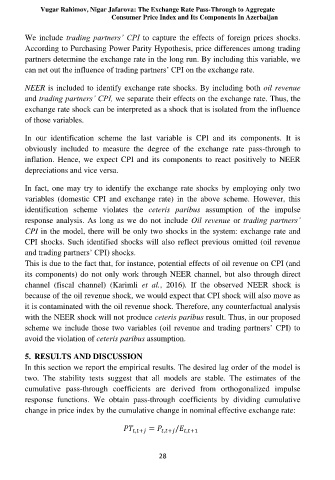
                    response  functions.  We  obtain  pass-through  coefficients  by  dividing  cumulative
                    change in price index by the cumulative change in nominal effective exchange rate:

                                                        ,  +    =      ,  +   /     ,  +1


                                                           28

