


Page 25 - Azerbaijan State University of Economics
P. 25
THE JOURNAL OF ECONOMIC SCIENCES: THEORY AND PRACTICE, V.78, # 2, 2021, pp. 17-42


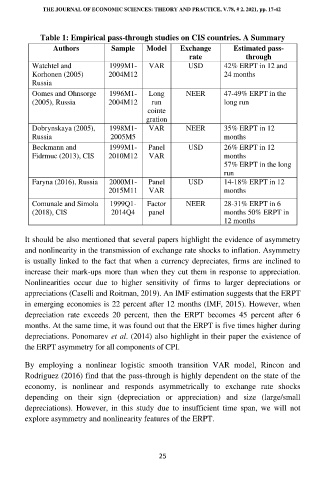
                        Table 1: Empirical pass-through studies on CIS countries. A Summary
                            Authors          Sample     Model     Exchange        Estimated pass-
                                                                    rate             through
                      Watchtel and           1999M1-    VAR         USD        42% ERPT in 12 and
                      Korhonen (2005)        2004M12                           24 months
                      Russia
                      Oomes and Ohnsorge     1996M1-    Long       NEER        47-49% ERPT in the
                      (2005), Russia         2004M12     run                   long run
                                                        cointe
                                                        gration
                      Dobrynskaya (2005),    1998M1-    VAR        NEER        35% ERPT in 12
                      Russia                 2005M5                            months
                      Beckmann and           1999M1-    Panel       USD        26% ERPT in 12
                      Fidrmuc (2013), CIS    2010M12    VAR                    months
                                                                               57% ERPT in the long
                                                                               run
                      Faryna (2016), Russia   2000M1-   Panel       USD        14-18% ERPT in 12
                                             2015M11    VAR                    months

                      Comunale and Simola    1999Q1-    Factor     NEER        28-31% ERPT in 6
                      (2018), CIS            2014Q4     panel                  months 50% ERPT in
                                                                               12 months

                    It should be also mentioned that several papers highlight the evidence of asymmetry
                    and nonlinearity in the transmission of exchange rate shocks to inflation. Asymmetry
                    is usually linked to the fact that when a currency depreciates, firms are inclined to
                    increase their mark-ups more than when they cut them in response to appreciation.
                    Nonlinearities  occur  due  to  higher  sensitivity  of  firms  to  larger  depreciations  or
                    appreciations (Caselli and Roitman, 2019). An IMF estimation suggests that the ERPT
                    in emerging economies is 22 percent after 12 months (IMF, 2015). However, when
                    depreciation  rate  exceeds  20  percent,  then  the  ERPT  becomes  45  percent  after  6
                    months. At the same time, it was found out that the ERPT is five times higher during
                    depreciations. Ponomarev et al. (2014) also highlight in their paper the existence of
                    the ERPT asymmetry for all components of CPI.

                    By  employing  a  nonlinear  logistic  smooth  transition  VAR  model,  Rincon  and
                    Rodriguez (2016) find that the pass-through is highly dependent on the state of the
                    economy,  is  nonlinear  and  responds  asymmetrically  to  exchange  rate  shocks
                    depending  on  their  sign  (depreciation  or  appreciation)  and  size  (large/small
                    depreciations).  However,  in  this  study  due  to  insufficient  time  span,  we  will  not
                    explore asymmetry and nonlinearity features of the ERPT.


                                                           25

