


Page 21 - Azerbaijan State University of Economics
P. 21
THE JOURNAL OF ECONOMIC SCIENCES: THEORY AND PRACTICE, V.78, # 2, 2021, pp. 17-42


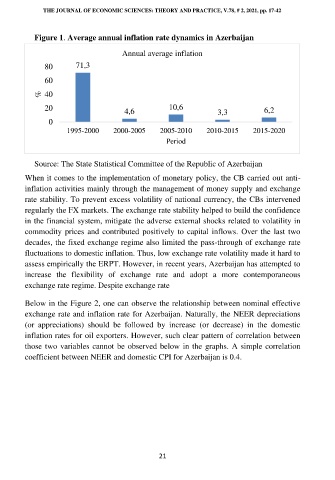
                       Figure 1. Average annual inflation rate dynamics in Azerbaijan

                                                 Annual average inflation
                          80       71,3

                          60
                        %  40

                          20                     4,6          10,6           3,3           6,2
                           0
                                1995-2000     2000-2005     2005-2010     2010-2015    2015-2020
                                                              Period

                       Source: The State Statistical Committee of the Republic of Azerbaijan

                    When it comes to the implementation of monetary policy, the CB carried out anti-
                    inflation activities mainly through the management of money supply and exchange
                    rate stability. To prevent excess volatility of national currency, the CBs intervened
                    regularly the FX markets. The exchange rate stability helped to build the confidence
                    in the financial system, mitigate the adverse external shocks related to volatility in
                    commodity prices and contributed positively to  capital inflows. Over the last two
                    decades, the fixed exchange regime also limited the pass-through of exchange rate
                    fluctuations to domestic inflation. Thus, low exchange rate volatility made it hard to
                    assess empirically the ERPT. However, in recent years, Azerbaijan has attempted to
                    increase  the  flexibility  of  exchange  rate  and  adopt  a  more  contemporaneous
                    exchange rate regime. Despite exchange rate

                    Below in the Figure 2, one can observe the relationship between nominal effective
                    exchange rate and inflation rate for Azerbaijan. Naturally, the NEER depreciations
                    (or  appreciations)  should  be  followed  by  increase  (or  decrease)  in  the  domestic
                    inflation rates for oil exporters. However, such clear pattern of correlation between
                    those two variables cannot be observed below in the graphs. A simple correlation
                    coefficient between NEER and domestic CPI for Azerbaijan is 0.4.


                                                           21

