


Page 22 - Azerbaijan State University of Economics
P. 22
Vugar Rahimov, Nigar Jafarova: The Exchange Rate Pass-Through to Aggregate
                                                                  Consumer Price Index and Its Components In Azerbaijan

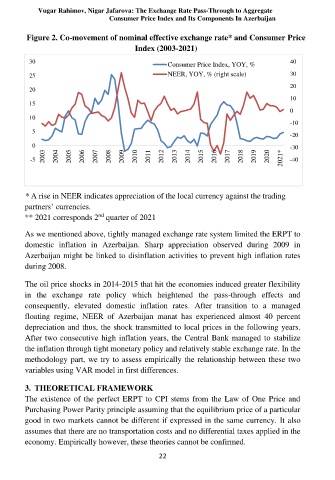
                    Figure 2. Co-movement of nominal effective exchange rate* and Consumer Price
                                                    Index (2003-2021)
                     30                                                                           40
                                                              Consumer Price Index, YOY, %
                     25                                       NEER, YOY, % (right scale)          30
                                                                                                  20
                     20
                                                                                                  10
                     15
                                                                                                  0
                     10
                                                                                                  -10
                      5
                                                                                                  -20
                      0                                                                           -30
                          2003  2004  2005  2006  2007  2008  2009  2010  2011  2012  2013  2014  2015  2016  2017  2018  2019  2020
                     -5                                                                         2021*  -40


                    * A rise in NEER indicates appreciation of the local currency against the trading
                    partners’ currencies.
                                         nd
                    ** 2021 corresponds 2  quarter of 2021

                    As we mentioned above, tightly managed exchange rate system limited the ERPT to
                    domestic  inflation  in  Azerbaijan.  Sharp  appreciation  observed  during  2009  in
                    Azerbaijan might be linked to disinflation activities to prevent high inflation rates
                    during 2008.

                    The oil price shocks in 2014-2015 that hit the economies induced greater flexibility
                    in  the  exchange  rate  policy  which  heightened  the  pass-through  effects  and
                    consequently,  elevated  domestic  inflation  rates.  After  transition  to  a  managed
                    floating  regime,  NEER  of  Azerbaijan  manat  has  experienced  almost  40  percent
                    depreciation and thus, the shock transmitted to local prices in the following years.
                    After two consecutive high inflation years, the Central Bank managed to stabilize
                    the inflation through tight monetary policy and relatively stable exchange rate. In the
                    methodology part, we try to assess empirically the relationship between these two
                    variables using VAR model in first differences.

                    3.  THEORETICAL FRAMEWORK
                    The existence of the perfect ERPT to CPI stems from the Law of One Price and
                    Purchasing Power Parity principle assuming that the equilibrium price of a particular
                    good in two markets cannot be different if expressed in the same currency. It also
                    assumes that there are no transportation costs and no differential taxes applied in the
                    economy. Empirically however, these theories cannot be confirmed.

                                                           22

