


Page 7 - Azerbaijan State University of Economics
P. 7
Yadulla Hasanli, Nazim Hajiyev, Gunay Rahimli:Distribution and Analysis of Admission
                                                                                                                Scores (In the Case of Azerbaijan

                    In  the  table,  scores  collected  by  applicants  are  divided  into  35  intervals  each  of
                    which  by  20  points.  In  the  article,  scores  were  regrouped  using  Stercess  formula
                    (Newbold  et  al.,  2010).  Based  on  this  formula,  the  number  of  intervals  is:
                    1+log2700=1+9,45=10,45. We took  the number of intervals  12 and calculated the
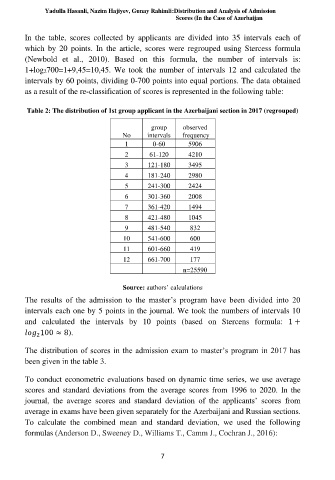
                    intervals by 60 points, dividing 0-700 points into equal portions. The data obtained
                    as a result of the re-classification of scores is represented in the following table:

                    Table 2: The distribution of 1st group applicant in the Azerbaijani section in 2017 (regrouped)

                                                         group     observed
                                                 No     intervals    frequency
                                                 1        0-60      5906
                                                 2       61-120     4210
                                                 3      121-180     3495
                                                 4      181-240     2980
                                                 5      241-300     2424
                                                 6      301-360     2008
                                                 7      361-420     1494
                                                 8      421-480     1045
                                                 9      481-540      832
                                                 10     541-600      600
                                                 11     601-660      419
                                                 12     661-700      177
                                                                   n=25590

                                                 Source: authors’ calculations
                    The  results  of  the  admission  to  the  master’s  program  have  been  divided  into  20
                    intervals each one by 5 points in the journal. We took the numbers of intervals 10
                    and  calculated  the  intervals  by  10  points  (based  on  Stercens  formula:  1 +
                           100 ≈ 8).
                       2

                    The distribution of scores in the admission exam to master’s program in 2017 has
                    been given in the table 3.

                    To conduct econometric evaluations based on dynamic time series, we use average
                    scores  and  standard  deviations  from  the  average  scores  from  1996  to  2020.  In  the
                    journal,  the  average  scores  and  standard  deviation  of  the  applicants’  scores  from
                    average in exams have been given separately for the Azerbaijani and Russian sections.
                    To  calculate  the  combined  mean  and  standard  deviation,  we  used  the  following
                    formulas (Anderson D., Sweeney D., Williams T., Camm J., Cochran J., 2016):


                                                            7

