


Page 28 - Azerbaijan State University of Economics
P. 28
Murad Y. Yusıfov: Econometrıc Assessment Of Optımal Interest Burden: Case Study For Azerbaıjan


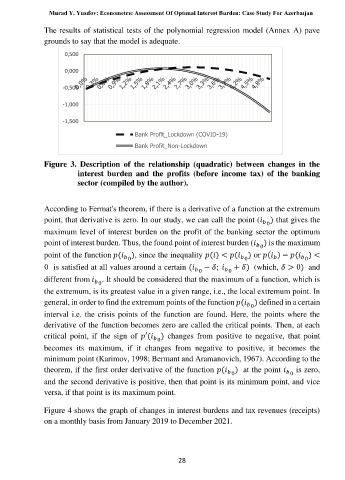
                    The results of statistical tests of the polynomial regression model (Annex A) pave
                    grounds to say that the model is adequate.

                          0,500

                          0,000

                         -0,500

                         -1,000

                         -1,500
                                               Bank Profit_Lockdown (COVID-19)
                                               Bank Profit_Non-Lockdown


                    Figure  3.  Description  of  the  relationship  (quadratic)  between  changes  in  the
                              interest  burden  and  the  profits  (before  income  tax)  of  the  banking
                              sector (compiled by the author).


                    According to Fermat's theorem, if there is a derivative of a function at the extremum
                    point, that derivative is zero. In our study, we can call the point (   ) that gives the

                                                                                      0
                    maximum level of interest burden on the profit of the banking sector the optimum
                    point of interest burden. Thus, the found point of interest burden (   ) is the maximum

                                                                                    0
                    point of the function   (   ), since the inequality   (  ) <   (   ) or   (   ) −   (   ) <


                                            0
                                                                                                 0
                                                                               0
                    0  is satisfied at all values around a certain (      0  −   ;       0  +   )  (which,    > 0)  and
                    different from    . It should be considered that the maximum of a function, which is

                                    0
                    the extremum, is its greatest value in a given range, i.e., the local extremum point. In
                    general, in order to find the extremum points of the function   (   ) defined in a certain

                                                                                 0
                    interval i.e. the crisis points of the function are found. Here, the points where the
                    derivative of the function becomes zero are called the critical points. Then, at each
                    critical  point,  if  the  sign  of    ′(   )  changes  from  positive  to  negative,  that  point

                                                     0
                    becomes  its  maximum,  if  it  changes  from  negative  to  positive,  it  becomes  the
                    minimum point (Karimov, 1998; Bermant and Aramanovich, 1967). According to the
                    theorem, if the first order derivative of the function   (   )  at the point     is zero,


                                                                                            0
                                                                           0
                    and the second derivative is positive, then that point is its minimum point, and vice
                    versa, if that point is its maximum point.

                    Figure 4 shows the graph of changes in interest burdens and tax revenues (receipts)
                    on a monthly basis from January 2019 to December 2021.


                                                           28

