


Page 30 - Azerbaijan State University of Economics
P. 30
Murad Y. Yusıfov: Econometrıc Assessment Of Optımal Interest Burden: Case Study For Azerbaıjan

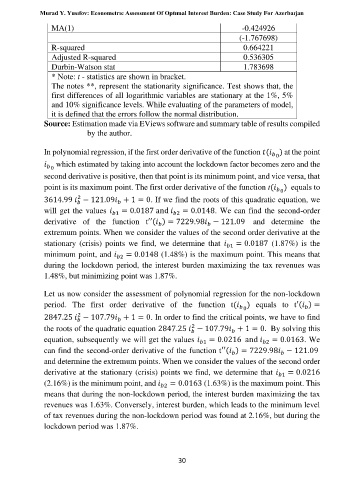
                      MA(1)                                                   -0.424926
                                                                             (-1.767698)


                      R-squared                                                0.664221
                      Adjusted R-squared                                       0.536305
                      Durbin-Watson stat                                       1.783698
                      * Note: t - statistics are shown in bracket.
                      The notes **, represent the stationarity significance. Test shows that, the
                      first differences of all logarithmic variables are stationary at the 1%, 5%
                      and 10% significance levels. While evaluating of the parameters of model,
                      it is defined that the errors follow the normal distribution.
                    Source: Estimation made via EViews software and summary table of results compiled
                                by the author.

                    In polynomial regression, if the first order derivative of the function   (   ) at the point

                                                                                        0
                        which estimated by taking into account the lockdown factor becomes zero and the

                      0
                    second derivative is positive, then that point is its minimum point, and vice versa, that
                    point is its maximum point. The first order derivative of the function t(   )  equals to

                                                                                          0
                              2
                    3614.99    − 121.09   + 1 = 0. If we find the roots of this quadratic equation, we


                    will get the values      1  = 0.0187 and      2  = 0.0148. We can find the second-order
                    derivative  of  the  function  t′′(   ) = 7229.98   − 121.09   and  determine  the


                    extremum points. When we consider the values of the second order derivative at the
                    stationary  (crisis)  points  we  find,  we  determine  that       1  = 0.0187  (1.87%)  is  the
                    minimum point, and      2  = 0.0148 (1.48%) is the maximum point. This means that
                    during the lockdown period, the interest burden maximizing the tax revenues was
                    1.48%, but minimizing point was 1.87%.

                    Let us now consider the assessment of polynomial regression for the non-lockdown
                    period.  The  first  order  derivative  of  the  function  t(   )  equals  to  t′(   ) =


                                                                               0
                              2
                    2847.25    − 107.79   + 1 = 0. In order to find the critical points, we have to find


                                                               2
                    the roots of the quadratic equation 2847.25    − 107.79   + 1 = 0.  By solving this


                    equation, subsequently we will get the values      1  = 0.0216  and      2  = 0.0163. We
                    can find the second-order derivative of the function t′′(   ) = 7229.98   − 121.09


                    and determine the extremum points. When we consider the values of the second order
                    derivative at the stationary (crisis) points we find, we determine that      1  = 0.0216
                    (2.16%) is the minimum point, and      2  = 0.0163 (1.63%) is the maximum point. This
                    means that during the non-lockdown period, the interest burden maximizing the tax
                    revenues was 1.63%. Conversely, interest burden, which leads to the minimum level
                    of tax revenues during the non-lockdown period was found at 2.16%, but during the
                    lockdown period was 1.87%.


                                                           30

