


Page 9 - Azerbaijan State University of Economics
P. 9
Hadouga. H: Prediction Of Agricultural Growth Rate As A Result Of Agricultural Reforms

                    where s and j are the splitting point and variables, respectively. Further, s and j are
                    used for achieving the most uniform splitting group.
                    The embedding formulation in (Atkeson,1997).suggests that, once a historical record
                    S is available, the problem of one-step forecasting can be tackled as a problem of
                    supervised learning. Supervised learning consists  in  modeling,  on  the  basis  of a
                    finite set of observations, the relation between a set of input variables and one or
                    more output  variables, which are considered somewhat dependent on the inputs.
                    Once a model of the mapping is available, it can be used for one-step forecasting.
                    In one-step forecasting, the n previous values of the series are available and the
                    forecasting problem can be cast in the form of a generic regression problem.

                    A multi-step time series forecasting task consists of predicting the next H
                    values [yN+1,... , yN+H ] of a historical  time series  [y 1,..., yN ] composed of  N
                    observations, where H > 1 denotes the forecasting horizon. (Casdagli, 1991)

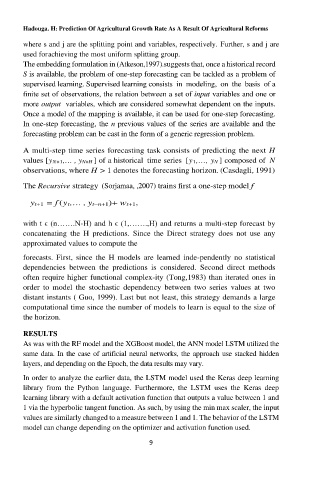
                    The Recursive strategy  (Sorjamaa, ,2007) trains first a one-step model f

                      yt+1 = f (yt,... , yt−n+1)+ wt+1,

                    with t ϵ (n…….N-H) and h ϵ (1,…….,H) and returns a multi-step forecast by
                    concatenating  the  H  predictions.  Since  the  Direct  strategy  does  not  use  any
                    approximated values to compute the
                    forecasts.  First,  since  the  H  models  are  learned  inde-pendently  no  statistical
                    dependencies  between  the  predictions  is  considered.  Second  direct  methods
                    often require higher functional complex-ity (Tong,1983) than iterated ones in
                    order  to  model  the  stochastic  dependency  between  two  series  values  at  two
                    distant instants ( Guo, 1999). Last but not least, this strategy demands a large
                    computational time since the number of models to learn is equal to the size of
                    the horizon.

                    RESULTS
                    As was with the RF model and the XGBoost model, the ANN model LSTM utilized the
                    same data. In the case of artificial neural networks, the approach use stacked hidden
                    layers, and depending on the Epoch, the data results may vary.

                    In order to analyze the earlier data, the LSTM model used the Keras deep learning
                    library  from  the  Python  language.  Furthermore,  the  LSTM  uses  the  Keras  deep
                    learning library with a default activation function that outputs a value between 1 and
                    1 via the hyperbolic tangent function. As such, by using the min max scaler, the input
                    values are similarly changed to a measure between 1 and 1. The behavior of the LSTM
                    model can change depending on the optimizer and activation function used.


                                                            9

