


Page 49 - Azerbaijan State University of Economics
P. 49
Mbu Daniel Tambi, Mah-Soh Glennice Fosah: Econometric Modelling of Women
Empowerment and Agricultural Production in Cameroon
2
The R of the OLS is 0.2435 which implies that the regression explains about 24% of the
variation in agricultural production. The coefficient on women empowerment in the OLS
estimation is smaller than that of the 2SLS and statistically significant but is likely to be
biased and inappropriate for inference as the model violates the first OLS assumption.
This explains why women empowerment is negatively significant in the OLS model, as
such we limit our discussions to the 2SLS and Control function estimates. We assume
unobservable variables are uncorrelated with excluded instruments or that the correlation
in linear and the estimation sample is randomly selected from the given population of
interest. In order to proceed with the 2SLS estimation technique, we test for instrument
2
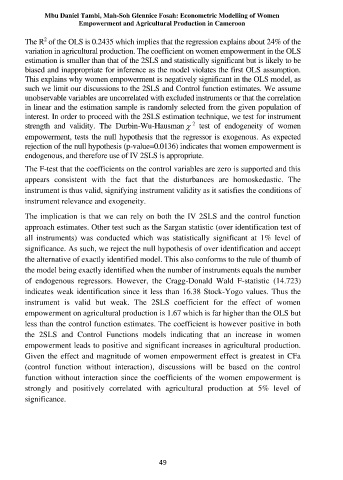
strength and validity. The Durbin-Wu-Hausman test of endogeneity of women
empowerment, tests the null hypothesis that the regressor is exogenous. As expected
rejection of the null hypothesis (p-value=0.0136) indicates that women empowerment is
endogenous, and therefore use of IV 2SLS is appropriate.
The F-test that the coefficients on the control variables are zero is supported and this
appears consistent with the fact that the disturbances are homoskedastic. The
instrument is thus valid, signifying instrument validity as it satisfies the conditions of
instrument relevance and exogeneity.
The implication is that we can rely on both the IV 2SLS and the control function
approach estimates. Other test such as the Sargan statistic (over identification test of
all instruments) was conducted which was statistically significant at 1% level of
significance. As such, we reject the null hypothesis of over identification and accept
the alternative of exactly identified model. This also conforms to the rule of thumb of
the model being exactly identified when the number of instruments equals the number
of endogenous regressors. However, the Cragg-Donald Wald F-statistic (14.723)
indicates weak identification since it less than 16.38 Stock-Yogo values. Thus the
instrument is valid but weak. The 2SLS coefficient for the effect of women
empowerment on agricultural production is 1.67 which is far higher than the OLS but
less than the control function estimates. The coefficient is however positive in both
the 2SLS and Control Functions models indicating that an increase in women
empowerment leads to positive and significant increases in agricultural production.
Given the effect and magnitude of women empowerment effect is greatest in CFa
(control function without interaction), discussions will be based on the control
function without interaction since the coefficients of the women empowerment is
strongly and positively correlated with agricultural production at 5% level of
significance.
49

