


Page 75 - Azerbaijan State University of Economics
P. 75
Abderrahmane Benouaret: Towards Regulating Freelance Work and the Informal
                           Economy in Algeria: Will the Self-Employed Contractor Law Suffice?

                    By  referring  to  this  list  provided  by  the  National  Agency  for  Self-employed
                    Contractors  and  researching  its  online  platform,  the  scope  and  type  of  freelance
                    activities  of  Algerian  workers  studied  in  this  research  paper  can  be  determined,
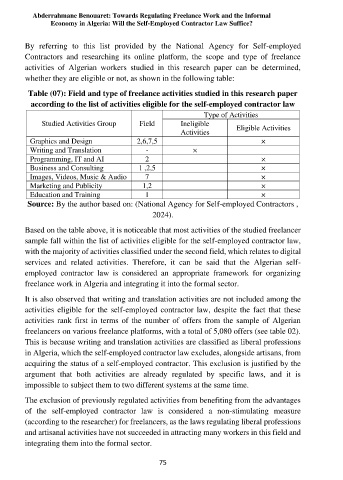
                    whether they are eligible or not, as shown in the following table:

                     Table (07): Field and type of freelance activities studied in this research paper
                     according to the list of activities eligible for the self-employed contractor law
                                                                         Type of Activities
                         Studied Activities Group     Field       Ineligible
                                                                  Activities      Eligible Activities
                     Graphics and Design             2,6,7,5                              ×
                     Writing and Translation            -            ×
                     Programming, IT and AI            2                                  ×
                     Business and Consulting         1 ,2,5                               ×
                     Images, Videos, Music & Audio     7                                  ×
                     Marketing and Publicity           1,2                                ×
                     Education and Training            1                                  ×
                    Source: By the author based on: (National Agency for Self-employed Contractors ,
                                                         2024).

                    Based on the table above, it is noticeable that most activities of the studied freelancer
                    sample fall within the list of activities eligible for the self-employed contractor law,
                    with the majority of activities classified under the second field, which relates to digital
                    services  and  related  activities.  Therefore,  it  can  be  said  that  the  Algerian  self-
                    employed  contractor  law  is  considered  an  appropriate  framework  for  organizing
                    freelance work in Algeria and integrating it into the formal sector.

                    It is also observed that writing and translation activities are not included among the
                    activities eligible for the self-employed contractor law, despite the fact  that these
                    activities rank first in terms of the number of offers from the sample of Algerian
                    freelancers on various freelance platforms, with a total of 5,080 offers (see table 02).
                    This is because writing and translation activities are classified as liberal professions
                    in Algeria, which the self-employed contractor law excludes, alongside artisans, from
                    acquiring the status of a self-employed contractor. This exclusion is justified by the
                    argument  that  both  activities  are  already  regulated  by  specific  laws,  and  it  is
                    impossible to subject them to two different systems at the same time.

                    The exclusion of previously regulated activities from benefiting from the advantages
                    of  the  self-employed  contractor  law  is  considered  a  non-stimulating  measure
                    (according to the researcher) for freelancers, as the laws regulating liberal professions
                    and artisanal activities have not succeeded in attracting many workers in this field and
                    integrating them into the formal sector.


                                                           75

