


Page 76 - Azerbaijan State University of Economics
P. 76
THE                      JOURNAL OF ECONOMIC SCIENCES: THEORY AND PRACTICE, V.81, # 2, 2024, pp. 60-83

                    Liberal professions and artisanal activities, under Algerian tax laws, are subject to a
                    single flat tax ranging between 5% or 12% of the annual turnover, depending on the
                    type of activity (General Directorate of Taxes, 2023). This tax rate may be one of the
                    reasons  why  many  freelancers  do  not  engage  in  the  formal  economy,  whereas
                    freelancers falling under the self-employed contractor law are subject to a preferential
                    tax  system,  which  imposes  a  single  flat  tax  of  only  0.5%  of  annual  turnover,  in
                    addition  to  other  previously  mentioned  benefits.  Therefore,  it  would  have  been
                    preferable  to  give  freelancers  whose  activities  are  already  regulated  the  option  to
                    choose between adhering to the old legal system and the self-employed contractor
                    system. This would serve as an incentive for many freelancers to reconsider their
                    stance and join the formal sector.

                    On  the  other  hand,  one  criticism  of  the  self-employed  contractor  law  in  Algeria
                    (according to the researcher) is its reliance on the regulations in each sector to resolve
                    many contentious issues. Many individuals working for themselves also hold official
                    positions either in public service or in the public and private economic sectors, and
                    they carry out their private work remotely or after hours, during weekends, or on
                    annual holidays. Since Algerian labor law prohibits holding dual jobs, this creates a
                    significant obstacle to incorporating after-hours activities into the formal sector.

                    For example, in the field of education in Algeria, many teachers engage in additional
                    work after their official hours, providing private tutoring sessions to students. These
                    are  additional  support  lessons  offered  to  students  to  reinforce  their  knowledge.
                    Although the self-employed contractor law includes this activity among those eligible
                    to  benefit from it, teachers in  the education sector cannot obtain a self-employed
                    contractor card due to the law prohibiting dual jobs, which forces them to carry out
                    this activity within the informal framework.

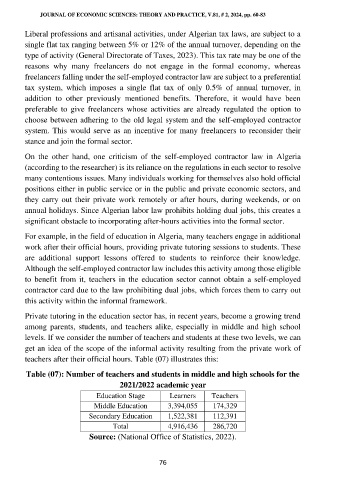
                    Private tutoring in the education sector has, in recent years, become a growing trend
                    among parents, students, and teachers alike, especially in middle and high school
                    levels. If we consider the number of teachers and students at these two levels, we can
                    get an idea of the scope of the informal activity resulting from the private work of
                    teachers after their official hours. Table (07) illustrates this:

                    Table (07): Number of teachers and students in middle and high schools for the
                                                2021/2022 academic year
                                         Education Stage       Learners    Teachers
                                        Middle Education      3,394,055    174,329
                                       Secondary Education    1,522,381    112,391
                                              Total           4,916,436    286,720
                                       Source: (National Office of Statistics, 2022).


                                                           76

