


Page 120 - Azerbaijan State University of Economics
P. 120
Yadulla Hasanli, Gunay Rahimli, Fuad Quliyev, Mattia Ferrari: Evaluation of Sectoral
                                                             Foreign Trade Elasticities of Azerbaijan


                    whereby,     is a parameter representing the efficiency of substituting quantities of

                    products sold in the export and domestic markets for the i-th production sector,

                    and       are CET distribution parameters, and      is used to calculate the elasticity of


                    substitution between products sold in the export and domestic markets. The elasticity
                    of substitution between exported and domestic products is then computed as     =

                     1
                        .
                    1+

                    As shown, this is also a conditional optimization problem, and solving it using the
                    method  of  Lagrange  multipliers  allows  us  to  determine  the  portion  of  the  i-th
                    production sector’s output that should be sold in the domestic market and the portion
                    that  should  be  exported.  From  this  solution,  the  relative  volume  of  exported  to
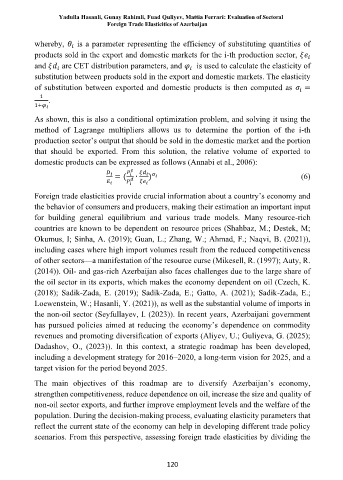
                    domestic products can be expressed as follows (Annabi et al., 2006):

                                           = (    ∙  )                                              (6)


                    Foreign trade elasticities provide crucial information about a country’s economy and
                    the behavior of consumers and producers, making their estimation an important input
                    for  building  general  equilibrium  and  various  trade  models.  Many  resource-rich
                    countries are known to be dependent on resource prices (Shahbaz, M.; Destek, M;
                    Okumus, I; Sinha, A. (2019); Guan, L.; Zhang, W.; Ahmad, F.; Naqvi, B. (2021)),
                    including cases where high import volumes result from the reduced competitiveness
                    of other sectors—a manifestation of the resource curse (Mikesell, R. (1997); Auty, R.
                    (2014)). Oil- and gas-rich Azerbaijan also faces challenges due to the large share of
                    the oil sector in its exports, which makes the economy dependent on oil (Czech, K.
                    (2018); Sadik-Zada, E.  (2019);  Sadik-Zada, E.;  Gatto, A. (2021); Sadik-Zada, E.;
                    Loewenstein, W.; Hasanli, Y. (2021)), as well as the substantial volume of imports in
                    the non-oil sector (Seyfullayev, I. (2023)). In recent years, Azerbaijani government
                    has pursued policies aimed at reducing the economy’s dependence on commodity
                    revenues and promoting diversification of exports (Aliyev, U.; Guliyeva, G. (2025);
                    Dadashov,  O.,  (2023)).  In  this  context,  a  strategic  roadmap  has  been  developed,
                    including a development strategy for 2016–2020, a long-term vision for 2025, and a
                    target vision for the period beyond 2025.

                    The  main  objectives  of  this  roadmap  are  to  diversify  Azerbaijan’s  economy,
                    strengthen competitiveness, reduce dependence on oil, increase the size and quality of
                    non-oil sector exports, and further improve employment levels and the welfare of the
                    population. During the decision-making process, evaluating elasticity parameters that
                    reflect the current state of the economy can help in developing different trade policy
                    scenarios. From this perspective, assessing foreign trade elasticities by dividing the


                                                           120

