


Page 73 - Azerbaijan State University of Economics
P. 73
THE                      JOURNAL OF ECONOMIC SCIENCES: THEORY AND PRACTICE, V.82, # 2, 2025, pp. 61-78

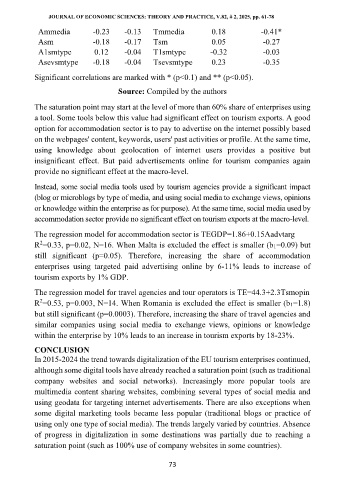
                     Ammedia         -0.23    -0.13    Tmmedia          0.18           -0.41*
                     Asm             -0.18    -0.17    Tsm              0.05           -0.27
                     A1smtype        0.12     -0.04    T1smtype         -0.32          -0.03
                     Asevsmtype      -0.18    -0.04    Tsevsmtype       0.23           -0.35

                    Significant correlations are marked with * (p<0.1) and ** (p<0.05).
                                            Source: Compiled by the authors

                    The saturation point may start at the level of more than 60% share of enterprises using
                    a tool. Some tools below this value had significant effect on tourism exports. A good
                    option for accommodation sector is to pay to advertise on the internet possibly based
                    on the webpages' content, keywords, users' past activities or profile. At the same time,
                    using  knowledge  about  geolocation  of  internet  users  provides  a  positive  but
                    insignificant  effect.  But  paid  advertisements  online  for  tourism  companies  again
                    provide no significant effect at the macro-level.

                    Instead, some social media tools used by tourism agencies provide a significant impact
                    (blog or microblogs by type of media, and using social media to exchange views, opinions
                    or knowledge within the enterprise as for purpose). At the same time, social media used by
                    accommodation sector provide no significant effect on tourism exports at the macro-level.

                    The regression model for accommodation sector is TEGDP=1.86+0.15Aadvtarg
                     2
                    R =0.33, p=0.02, N=16. When Malta is excluded the effect is smaller (b1=0.09) but
                    still  significant  (p=0.05).  Therefore,  increasing  the  share  of  accommodation
                    enterprises  using  targeted  paid  advertising  online  by  6-11%  leads  to  increase  of
                    tourism exports by 1% GDP.

                    The regression model for travel agencies and tour operators is TE=44.3+2.3Tsmopin
                     2
                    R =0.53, p=0.003, N=14. When Romania is excluded the effect is smaller (b1=1.8)
                    but still significant (p=0.0003). Therefore, increasing the share of travel agencies and
                    similar  companies  using  social  media  to  exchange  views,  opinions  or  knowledge
                    within the enterprise by 10% leads to an increase in tourism exports by 18-23%.

                    CONCLUSION
                    In 2015-2024 the trend towards digitalization of the EU tourism enterprises continued,
                    although some digital tools have already reached a saturation point (such as traditional
                    company  websites  and  social  networks).  Increasingly  more  popular  tools  are
                    multimedia content sharing websites, combining several types of social media and
                    using geodata for targeting internet advertisements. There are also exceptions when
                    some digital marketing tools became less popular (traditional blogs or practice of
                    using only one type of social media). The trends largely varied by countries. Absence
                    of  progress  in  digitalization  in  some  destinations  was  partially  due  to  reaching  a
                    saturation point (such as 100% use of company websites in some countries).


                                                           73

