


Page 88 - Azerbaijan State University of Economics
P. 88
THE                      JOURNAL OF ECONOMIC SCIENCES: THEORY AND PRACTICE, V.83, # 1, 2026, pp. 82-106


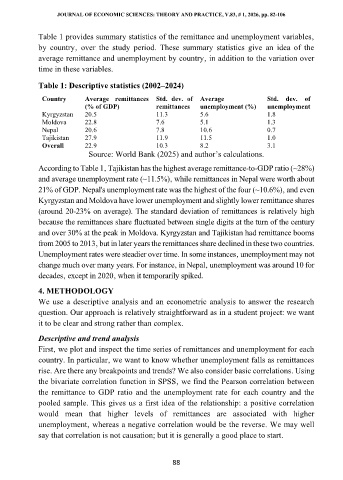
                    Table 1 provides summary statistics of the remittance and unemployment variables‚
                    by  country‚  over  the  study  period.  These  summary  statistics  give  an  idea  of  the
                    average remittance and unemployment by country‚ in addition to the variation over
                    time in these variables.

                    Table 1: Descriptive statistics (2002–2024)
                     Country     Average  remittances  Std.  dev.  of  Average         Std.  dev.  of
                                 (% of GDP)            remittances   unemployment (%)   unemployment
                     Kyrgyzstan   20.5                 11.3         5.6                1.8
                     Moldova     22.8                  7.6          5.1                1.3
                     Nepal       20.6                  7.8          10.6               0.7
                     Tajikistan   27.9                 11.9         11.5               1.0
                     Overall     22.9                  10.3         8.2                3.1
                                   Source: World Bank (2025) and author’s calculations.

                    According to Table 1‚ Tajikistan has the highest average remittance-to-GDP ratio (~28%)
                    and average unemployment rate (~11.5%)‚ while remittances in Nepal were worth about
                    21% of GDP. Nepal's unemployment rate was the highest of the four (~10.6%)‚ and even
                    Kyrgyzstan and Moldova have lower unemployment and slightly lower remittance shares
                    (around 20-23% on average). The standard deviation of remittances is relatively high
                    because the remittances share fluctuated between single digits at the turn of the century
                    and over 30% at the peak in Moldova. Kyrgyzstan and Tajikistan had remittance booms
                    from 2005 to 2013‚ but in later years the remittances share declined in these two countries.
                    Unemployment rates were steadier over time. In some instances‚ unemployment may not
                    change much over many years. For instance‚ in Nepal‚ unemployment was around 10 for
                    decades‚ except in 2020‚ when it temporarily spiked.

                    4. METHODOLOGY
                    We use a descriptive analysis and an econometric analysis to answer the research
                    question. Our approach is relatively straightforward as in a student project: we want
                    it to be clear and strong rather than complex.

                    Descriptive and trend analysis
                    First‚ we plot and inspect the time series of remittances and unemployment for each
                    country. In particular‚ we want to know whether unemployment falls as remittances
                    rise. Are there any breakpoints and trends? We also consider basic correlations. Using
                    the bivariate correlation function in SPSS‚ we find the Pearson correlation between
                    the remittance to  GDP ratio and the unemployment rate for each country and the
                    pooled sample. This gives us a first idea of the relationship: a positive correlation
                    would  mean  that  higher  levels  of  remittances  are  associated  with  higher
                    unemployment‚ whereas a negative correlation would be the reverse. We may well
                    say that correlation is not causation; but it is generally a good place to start.


                                                           88

