


Page 91 - Azerbaijan State University of Economics
P. 91
Fadai Mardanli Mehman, Vildan Zahidkizi Rizayeva:   Do Remittances Compensate for the
                        Labor Market Gaps Created by Emigration?


                    differ‚ such as  Kyrgyzstan vs. There are parallels with  two similar Central  Asian
                    economies‚ Tajikistan and Uzbekistan‚ which experience high levels of emigration.

                    5. RESULTS AND DISCUSSION
                    We first present the simple correlations between remittances as a share of GDP and
                    the unemployment rate‚ followed by our preferred regression analysis whereby we
                    control  for  other  country  specific  factors  that  affect  unemployment‚  and  finally
                    discuss the differences between the two countries.

                    Correlation analysis
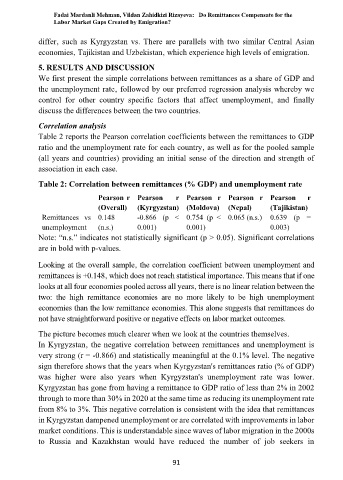
                    Table 2 reports the Pearson correlation coefficients between the remittances to GDP
                    ratio and the unemployment rate for each country‚ as well as for the pooled sample
                    (all years and countries) providing an initial sense of the direction and strength of
                    association in each case.

                    Table 2: Correlation between remittances (% GDP) and unemployment rate

                                     Pearson  r  Pearson    r  Pearson  r  Pearson  r  Pearson     r
                                     (Overall)   (Kyrgyzstan)  (Moldova)  (Nepal)       (Tajikistan)
                     Remittances  vs  0.148      -0.866  (p  <  0.754  (p  <  0.065 (n.s.)  0.639  (p  =
                     unemployment    (n.s.)      0.001)         0.001)                  0.003)
                    Note: “n.s.” indicates not statistically significant (p > 0.05). Significant correlations
                    are in bold with p-values.

                    Looking at the overall sample‚ the correlation coefficient between unemployment and
                    remittances is +0.148‚ which does not reach statistical importance. This means that if one
                    looks at all four economies pooled across all years‚ there is no linear relation between the
                    two:  the  high  remittance  economies  are  no  more  likely  to  be  high  unemployment
                    economies than the low remittance economies. This alone suggests that remittances do
                    not have straightforward positive or negative effects on labor market outcomes.

                    The picture becomes much clearer when we look at the countries themselves.
                    In Kyrgyzstan‚ the negative correlation between remittances and unemployment is
                    very strong (r = -0.866) and statistically meaningful at the 0.1% level. The negative
                    sign therefore shows that the years when Kyrgyzstan's remittances ratio (% of GDP)
                    was  higher  were  also  years  when  Kyrgyzstan's  unemployment  rate  was  lower.
                    Kyrgyzstan has gone from having a remittance to GDP ratio of less than 2% in 2002
                    through to more than 30% in 2020 at the same time as reducing its unemployment rate
                    from 8% to 3%. This negative correlation is consistent with the idea that remittances
                    in Kyrgyzstan dampened unemployment or are correlated with improvements in labor
                    market conditions. This is understandable since waves of labor migration in the 2000s
                    to  Russia  and  Kazakhstan  would  have  reduced  the  number  of  job  seekers  in


                                                           91

