


Page 94 - Azerbaijan State University of Economics
P. 94
THE                      JOURNAL OF ECONOMIC SCIENCES: THEORY AND PRACTICE, V.83, # 1, 2026, pp. 82-106

                    market wage is‚ however‚ not self-obvious. Hence‚ we also use a regression model
                    controlling for country-level unobservable effects to study these relations.

                    6. REGRESSION ANALYSIS
                    We  used  linear  regressions  to  model  the  relationship  between  unemployment  and
                    remittances‚ separately by country‚ and pooled with country fixed effects. The regression
                    framework  allows  us  to  control  for  the  initial  level  of  country  unemployment  and
                    eliminate the possibility that our results are merely due to differences in unemployment
                    rates between countries. We first show the result of running the regressions separately for
                    each country‚ and then the pooled regressions with fixed effects.

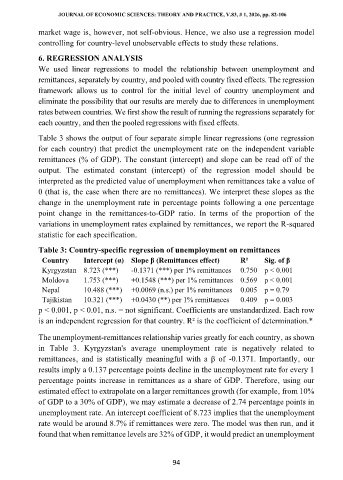
                    Table 3 shows the output of four separate simple linear regressions (one regression
                    for each country) that predict the unemployment rate on the independent variable
                    remittances (% of GDP). The constant (intercept) and slope can be read off of the
                    output.  The  estimated  constant  (intercept)  of  the  regression  model  should  be
                    interpreted as the predicted value of unemployment when remittances take a value of
                    0 (that is‚ the case when there are no remittances). We interpret these slopes as the
                    change in the unemployment rate in percentage points following a one percentage
                    point  change  in  the  remittances-to-GDP  ratio.  In  terms  of  the  proportion  of  the
                    variations in unemployment rates explained by remittances‚ we report the R-squared
                    statistic for each specification.

                    Table 3: Country-specific regression of unemployment on remittances
                     Country     Intercept (α)  Slope β (Remittances effect)   R²      Sig. of β
                     Kyrgyzstan  8.723 (***)   -0.1371 (***) per 1% remittances  0.750  p < 0.001
                     Moldova     1.753 (***)   +0.1548 (***) per 1% remittances  0.569  p < 0.001
                     Nepal       10.488 (***)  +0.0069 (n.s.) per 1% remittances  0.005  p = 0.79
                     Tajikistan   10.321 (***)  +0.0430 (**) per 1% remittances   0.409  p = 0.003
                    p < 0.001, p < 0.01, n.s. = not significant. Coefficients are unstandardized. Each row
                    is an independent regression for that country. R² is the coefficient of determination.*

                    The unemployment-remittances relationship varies greatly for each country‚ as shown
                    in  Table  3.  Kyrgyzstan's  average  unemployment  rate  is  negatively  related  to
                    remittances‚  and  is  statistically  meaningful  with  a  β  of  -0.1371.  Importantly‚  our
                    results imply a 0.137 percentage points decline in the unemployment rate for every 1
                    percentage points increase in remittances as a share of GDP. Therefore‚ using our
                    estimated effect to extrapolate on a larger remittances growth (for example‚ from 10%
                    of GDP to a 30% of GDP)‚ we may estimate a decrease of 2.74 percentage points in
                    unemployment rate. An intercept coefficient of 8.723 implies that the unemployment
                    rate would be around 8.7% if remittances were zero. The model was then run‚ and it
                    found that when remittance levels are 32% of GDP‚ it would predict an unemployment


                                                           94

