


Page 97 - Azerbaijan State University of Economics
P. 97
Fadai Mardanli Mehman, Vildan Zahidkizi Rizayeva:   Do Remittances Compensate for the
                       Labor Market Gaps Created by Emigration?


                    depends on who will migrate‚ how remittances will be used‚ and whether productive
                    employment can be created in the country of origin based on migration income.

                    Pooled fixed-effects regression
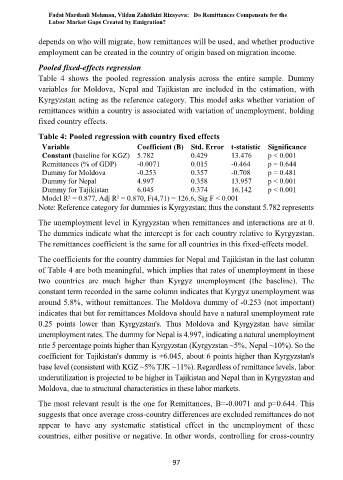
                    Table  4  shows  the  pooled  regression  analysis  across  the  entire  sample.  Dummy
                    variables  for  Moldova‚  Nepal  and  Tajikistan  are  included  in  the  estimation‚  with
                    Kyrgyzstan acting as the reference category. This model asks whether variation of
                    remittances within a country is associated with variation of unemployment‚ holding
                    fixed country effects.

                    Table 4: Pooled regression with country fixed effects
                     Variable                    Coefficient (B)  Std. Error  t-statistic  Significance
                     Constant (baseline for KGZ)  5.782          0.429       13.476     p < 0.001
                     Remittances (% of GDP)      -0.0071         0.015       -0.464     p = 0.644
                     Dummy for Moldova           -0.253          0.357       -0.708     p = 0.481
                     Dummy for Nepal             4.997           0.358       13.957     p < 0.001
                     Dummy for Tajikistan        6.045           0.374       16.142     p < 0.001
                     Model R² = 0.877, Adj R² = 0.870, F(4,71) = 126.6, Sig F < 0.001
                    Note: Reference category for dummies is Kyrgyzstan; thus the constant 5.782 represents

                    The unemployment level in Kyrgyzstan when remittances and interactions are at 0.
                    The dummies indicate what the intercept is for each country relative to Kyrgyzstan.
                    The remittances coefficient is the same for all countries in this fixed-effects model.

                    The coefficients for the country dummies for Nepal and Tajikistan in the last column
                    of Table 4 are both meaningful‚ which implies that rates of unemployment in these
                    two  countries  are  much  higher  than  Kyrgyz  unemployment  (the  baseline).  The
                    constant term recorded in the same column indicates that Kyrgyz unemployment was
                    around 5.8%‚ without remittances. The Moldova dummy of -0.253 (not important)
                    indicates that but for remittances Moldova should have a natural unemployment rate
                    0.25  points  lower  than  Kyrgyzstan's.  Thus  Moldova  and  Kyrgyzstan  have  similar
                    unemployment rates. The dummy for Nepal is 4.997‚ indicating a natural unemployment
                    rate 5 percentage points higher than Kyrgyzstan (Kyrgyzstan ~5%‚ Nepal ~10%). So the
                    coefficient for Tajikistan's dummy is +6.045‚ about 6 points higher than Kyrgyzstan's
                    base level (consistent with KGZ ~5% TJK ~11%). Regardless of remittance levels‚ labor
                    underutilization is projected to be higher in Tajikistan and Nepal than in Kyrgyzstan and
                    Moldova‚ due to structural characteristics in these labor markets.

                    The most relevant result is the one for Remittances‚ B=-0.0071 and p=0.644. This
                    suggests that once average cross-country differences are excluded remittances do not
                    appear  to  have  any  systematic  statistical  effect  in  the  unemployment  of  these
                    countries‚ either positive or negative. In other words‚ controlling for cross-country


                                                           97

