


Page 99 - Azerbaijan State University of Economics
P. 99
Fadai Mardanli Mehman, Vildan Zahidkizi Rizayeva:   Do Remittances Compensate for the
                        Labor Market Gaps Created by Emigration?


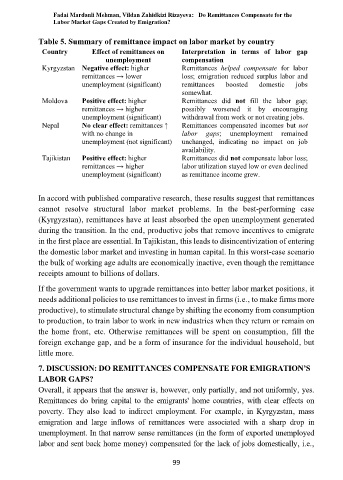
                    Table 5. Summary of remittance impact on labor market by country
                     Country        Effect of remittances on   Interpretation  in  terms  of  labor  gap
                                        unemployment          compensation
                     Kyrgyzstan  Negative effect: higher      Remittances  helped  compensate  for  labor
                                 remittances → lower          loss; emigration reduced surplus labor and
                                 unemployment (significant)   remittances   boosted   domestic   jobs
                                                              somewhat.
                     Moldova     Positive effect: higher      Remittances  did  not  fill  the  labor  gap;
                                 remittances → higher         possibly  worsened  it  by  encouraging
                                 unemployment (significant)   withdrawal from work or not creating jobs.
                     Nepal       No clear effect: remittances ↑   Remittances  compensated  incomes  but  not
                                 with no change in            labor  gaps;  unemployment  remained
                                 unemployment (not significant)   unchanged,  indicating  no  impact  on  job
                                                              availability.
                     Tajikistan   Positive effect: higher     Remittances did not compensate labor loss;
                                 remittances → higher         labor utilization stayed low or even declined
                                 unemployment (significant)   as remittance income grew.


                    In accord with published comparative research‚ these results suggest that remittances
                    cannot  resolve  structural  labor  market  problems.  In  the  best-performing  case
                    (Kyrgyzstan)‚ remittances have at least absorbed the open unemployment generated
                    during the transition. In the end‚ productive jobs that remove incentives to emigrate
                    in the first place are essential. In Tajikistan‚ this leads to disincentivization of entering
                    the domestic labor market and investing in human capital. In this worst-case scenario
                    the bulk of working age adults are economically inactive‚ even though the remittance
                    receipts amount to billions of dollars.

                    If the government wants to upgrade remittances into better labor market positions‚ it
                    needs additional policies to use remittances to invest in firms (i.e.‚ to make firms more
                    productive)‚ to stimulate structural change by shifting the economy from consumption
                    to production‚ to train labor to work in new industries when they return or remain on
                    the home front‚ etc. Otherwise remittances will be spent on consumption‚ fill the
                    foreign exchange gap‚ and be a form of insurance for the individual household‚ but
                    little more.

                    7. DISCUSSION: DO REMITTANCES COMPENSATE FOR EMIGRATION’S
                    LABOR GAPS?
                    Overall‚ it appears that the answer is‚ however‚ only partially‚ and not uniformly‚ yes.
                    Remittances do bring capital to the emigrants' home countries‚ with clear effects on
                    poverty.  They  also  lead  to  indirect  employment.  For  example‚  in  Kyrgyzstan‚  mass
                    emigration  and  large  inflows  of  remittances  were  associated  with  a  sharp  drop  in
                    unemployment. In that narrow sense remittances (in the form of exported unemployed
                    labor and sent back home money) compensated for the lack of jobs domestically‚ i.e.‚


                                                           99

