


Page 16 - Azerbaijan State University of Economics
P. 16
THE JOURNAL OF ECONOMIC SCIENCES: THEORY AND PRACTICE, V.74, # 1, 2017, pp. 10-22

                        THE JOURNAL OF ECONOMIC SCIENCES: THEORY AND PRACTICE, V.74, # 1, 2017, pp. 10-22


                         Thanks to new approaches to state control and supervision, the focus of the
                    control function shifts from conducting inspections and subsequent analysis of only
                    the results of inspections to the analysis of additional sources (criteria).
                         These  include  the  timely  submission  of  reports,  their  completeness,  the
                    consistency of data, the achievement of the indicators, the availability of automated
                    accounting  and  reporting  systems  and  their  compliance,  consumer  complaints,
                    information from other government agencies, etc.
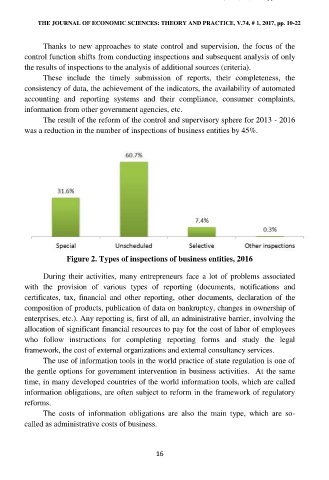
                         The result of the reform of the control and supervisory sphere for 2013 - 2016
                    was a reduction in the number of inspections of business entities by 45%.


                                Figure 2. Types of inspections of business entities, 2016

                         During  their  activities,  many  entrepreneurs  face  a  lot  of  problems  associated
                    with  the  provision  of  various  types  of  reporting  (documents,  notifications  and
                    certificates,  tax,  financial  and  other  reporting,  other  documents,  declaration  of  the
                    composition of products, publication of data on bankruptcy, changes in ownership of
                    enterprises, etc.). Any reporting is, first of all, an administrative barrier, involving the
                    allocation of significant financial resources to pay for the cost of labor of employees
                    who  follow  instructions  for  completing  reporting  forms  and  study  the  legal
                    framework, the cost of external organizations and external consultancy services.
                         The use of information tools in the world practice of state regulation is one of
                    the gentle options for government intervention in business activities.  At the same
                    time, in many developed countries of the world information tools, which are called
                    information obligations, are often subject to reform in the framework of regulatory
                    reforms.
                         The  costs  of  information  obligations  are  also  the  main  type,  which  are  so-
                    called as administrative costs of business.


                                                           16

