


Page 14 - Azerbaijan State University of Economics
P. 14
THE JOURNAL OF ECONOMIC SCIENCES: THEORY AND PRACTICE, V.74, # 1, 2017, pp. 10-22


                                                                                 50
                                                                46

                              34               33

                                                                                               % reduced


                             2011             2013             2014             2015

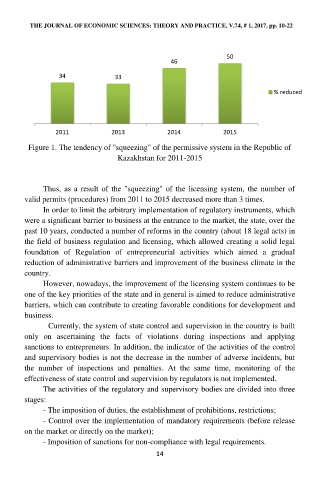
                     Figure 1. The tendency of "squeezing" of the permissive system in the Republic of
                                                Kazakhstan for 2011-2015


                         Thus, as  a result of the  "squeezing" of the licensing system, the number of
                    valid permits (procedures) from 2011 to 2015 decreased more than 3 times.
                         In order to limit the arbitrary implementation of regulatory instruments, which
                    were a significant barrier to business at the entrance to the market, the state, over the
                    past 10 years, conducted a number of reforms in the country (about 18 legal acts) in
                    the field of business regulation and licensing, which allowed creating a solid legal
                    foundation  of  Regulation  of  entrepreneurial  activities  which  aimed  a  gradual
                    reduction of administrative barriers and improvement of the business climate in the
                    country.
                         However, nowadays, the improvement of the licensing system continues to be
                    one of the key priorities of the state and in general is aimed to reduce administrative
                    barriers, which can contribute to creating favorable conditions for development and
                    business.
                           Currently, the system of state control and supervision in the country is built
                    only  on  ascertaining  the  facts  of  violations  during  inspections  and  applying
                    sanctions to entrepreneurs. In addition, the indicator of the activities of the control
                    and supervisory bodies is not the decrease in the number of adverse incidents, but
                    the  number  of  inspections  and  penalties.  At  the  same  time,  monitoring  of  the
                    effectiveness of state control and supervision by regulators is not implemented.
                         The activities of the regulatory and supervisory bodies are divided into three
                    stages:
                         - The imposition of duties, the establishment of prohibitions, restrictions;
                         - Control over the implementation of mandatory requirements (before release
                    on the market or directly on the market);
                         - Imposition of sanctions for non-compliance with legal requirements.

                                                           14

