


Page 30 - Azerbaijan State University of Economics
P. 30
THE JOURNAL OF ECONOMIC SCIENCES: THEORY AND PRACTICE, V.77, # 2, 2020, pp. 4-39


                     As  can  be  seen  from  T  able  No.  (10),  which  shows  the  order  of  entry  of  the
                    independent  variables  into  the  regression  equation,  the  individual  interest  variable
                    occupied  the  first  place  and  explained  an  amount  (31.8%)  of  the  variance  in  the
                    dependent variable, and the driving attractiveness variable entered as it was explained
                    with the individual interest variable. (40.7%) of the variance in the dependent variable,
                    and the inspiring motivation variable entered third, as it was explained with the previous
                    variables  (45.2%)  of  the  variance  in  the  dependent  variable.  Finally,  the  creative
                    encouragement  variable  entered,  where  it  explained  with  the  previous  variables  an
                    amount of (47.2%) of the variance in sensitivity Strategy as a dimension of strategic
                    agility as a dependent variable. The second sub-hypothesis: There is no statistically
                    significant  effect  at  the  level  of  significance  (α  >=-  0.05)  of  transformational
                    leadership in its dimensions (leadership attractiveness, inspiring motivation, creative
                    encouragement, individual interest) on organizational capabilities as a dimension of
                    strategic agility.
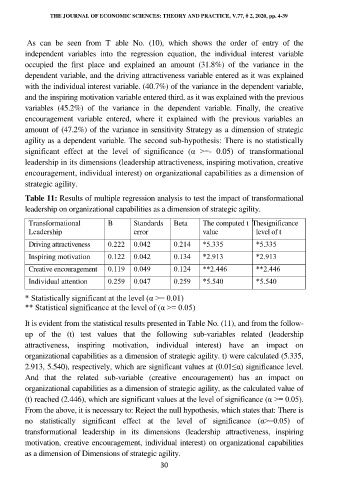
                    Table 11: Results of multiple regression analysis to test the impact of transformational
                    leadership on organizational capabilities as a dimension of strategic agility.

                     Transformational       B       Standards   Beta    The computed t  Thesignificance
                     Leadership                     error               value          level of t

                     Driving attractiveness   0.222  0.042     0.214    * 5.335        * 5.335
                     Inspiring motivation   0.122  0.042       0.134    * 2.913        * 2.913
                     Creative encouragement   0.119  0.049     0.124    ** 2.446       ** 2.446

                     Individual attention   0.259  0.047       0.259    * 5.540        * 5.540
                    * Statistically significant at the level (α >= 0.01)
                    ** Statistical significance at the level of (α >= 0.05)

                    It is evident from the statistical results presented in Table No. (11), and from the follow-
                    up  of  the  (t)  test  values  that  the  following  sub-variables  related  (leadership
                    attractiveness,  inspiring  motivation,  individual  interest)  have  an  impact  on
                    organizational capabilities as a dimension of strategic agility. t) were calculated (5.335,
                    2.913, 5.540), respectively, which are significant values at (0.01≤α) significance level.
                    And  that  the  related  sub-variable  (creative  encouragement)  has  an  impact  on
                    organizational capabilities as a dimension of strategic agility, as the calculated value of
                    (t) reached (2.446), which are significant values at the level of significance (α >= 0.05).
                    From the above, it is necessary to: Reject the null hypothesis, which states that: There is
                    no  statistically  significant  effect  at  the  level  of  significance  (α>=0.05)  of
                    transformational  leadership  in  its  dimensions  (leadership  attractiveness,  inspiring
                    motivation, creative encouragement, individual interest) on organizational capabilities
                    as a dimension of Dimensions of strategic agility.
                                                           30

