


Page 50 - Azerbaijan State University of Economics
P. 50
THE JOURNAL OF ECONOMIC SCIENCES: THEORY AND PRACTICE, V.77, # 2, 2020, pp. 40-60


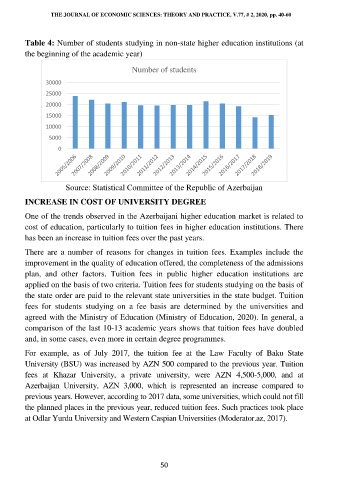
                    Table 4: Number of students studying in non-state higher education institutions (at
                    the beginning of the academic year)

                                                   Number of students

                          30000
                          25000
                          20000
                          15000
                          10000
                           5000
                             0


                                Source: Statistical Committee of the Republic of Azerbaijan

                    INCREASE IN COST OF UNIVERSITY DEGREE

                    One of the trends observed in the Azerbaijani higher education market is related to
                    cost of education, particularly to tuition fees in higher education institutions. There
                    has been an increase in tuition fees over the past years.
                    There  are  a  number  of  reasons  for  changes  in  tuition  fees.  Examples  include  the
                    improvement in the quality of education offered, the completeness of the admissions
                    plan,  and  other  factors.  Tuition  fees  in  public  higher  education  institutions  are
                    applied on the basis of two criteria. Tuition fees for students studying on the basis of
                    the state order are paid to the relevant state universities in the state budget. Tuition
                    fees  for  students  studying  on  a  fee  basis  are  determined  by  the  universities  and
                    agreed with the Ministry of Education (Ministry of Education, 2020). In general, a
                    comparison of the last 10-13 academic years shows that tuition fees have doubled
                    and, in some cases, even more in certain degree programmes.

                    For  example,  as  of  July  2017,  the  tuition  fee  at  the  Law  Faculty  of  Baku  State
                    University (BSU) was increased by AZN 500 compared to the previous year. Tuition
                    fees  at  Khazar  University,  a  private  university,  were  AZN  4,500-5,000,  and  at
                    Azerbaijan  University,  AZN  3,000,  which  is  represented  an  increase  compared  to
                    previous years. However, according to 2017 data, some universities, which could not fill
                    the planned places in the previous year, reduced tuition fees. Such practices took place
                    at Odlar Yurdu University and Western Caspian Universities (Moderator.az, 2017).


                                                           50

