


Page 54 - Azerbaijan State University of Economics
P. 54
THE JOURNAL OF ECONOMIC SCIENCES: THEORY AND PRACTICE, V.78, # 1, 2021, pp. 40-65


                            10
                        Long-term unemployment rate,   %  6
                             8


                             4

                             2
                             0


                                                     Russia and EU member states

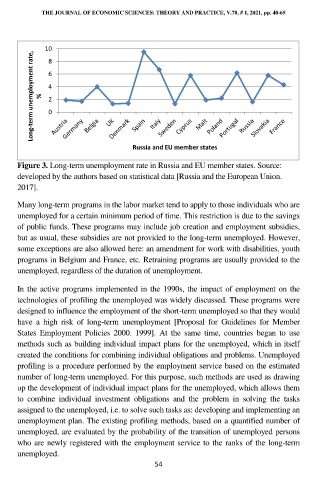
                    Figure 3. Long-term unemployment rate in Russia and EU member states. Source:
                    developed by the authors based on statistical data [Russia and the European Union.
                    2017].

                    Many long-term programs in the labor market tend to apply to those individuals who are
                    unemployed for a certain minimum period of time. This restriction is due to the savings
                    of public funds. These programs may include job creation and employment subsidies,
                    but as usual, these subsidies are not provided to the long-term unemployed. However,
                    some exceptions are also allowed here: an amendment for work with disabilities, youth
                    programs in Belgium and France, etc. Retraining programs are usually provided to the
                    unemployed, regardless of the duration of unemployment.

                    In the active programs implemented in the 1990s, the impact of employment on the
                    technologies of profiling the unemployed was widely discussed. These programs were
                    designed to influence the employment of the short-term unemployed so that they would
                    have  a  high  risk  of  long-term  unemployment  [Proposal  for  Guidelines  for  Member
                    States  Employment  Policies  2000.  1999].  At  the  same  time,  countries  began  to  use
                    methods such as building individual impact plans for the unemployed, which in itself
                    created the conditions for combining individual obligations and problems. Unemployed
                    profiling is a procedure performed by the employment service based on the estimated
                    number of long-term unemployed. For this purpose, such methods are used as drawing
                    up the development of individual impact plans for the unemployed, which allows them
                    to  combine  individual  investment  obligations  and  the  problem  in  solving  the  tasks
                    assigned to the unemployed, i.e. to solve such tasks as: developing and implementing an
                    unemployment plan. The existing profiling methods, based on a quantified number of
                    unemployed, are evaluated by the probability of the transition of unemployed persons
                    who are newly registered with the employment service to the ranks of the long-term
                    unemployed.
                                                           54

