


Page 53 - Azerbaijan State University of Economics
P. 53
Vilayat İsmayilov, Nahid Almasov, Sarraf Mirzayev:The Programme of  Reduction and
                                                                                    Profilling of Long-Term Unemployment in Azerbaijan


                             3.1
                         Long-term unemployment   rate, %  2.8
                              3
                             2.9

                             2.7
                             2.6
                             2.5
                             2.4
                             2.3
                                  2010 2011 2012 2013 2014 2015 2016 2017 2018 2019 2020
                                                               Years


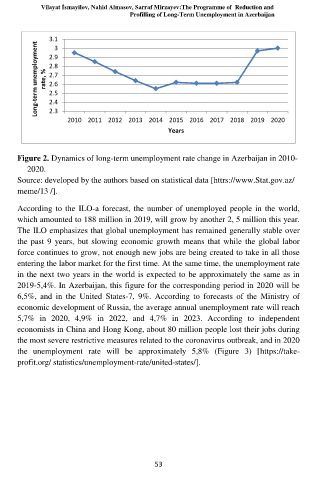
                    Figure 2. Dynamics of long-term unemployment rate change in Azerbaijan in 2010-
                       2020.
                    Source: developed by the authors based on statistical data [httrs://www.Stat.gov.az/
                    meme/13 /].

                    According to the ILO-a forecast, the number of unemployed people in the world,
                    which amounted to 188 million in 2019, will grow by another 2, 5 million this year.
                    The ILO emphasizes that global unemployment has remained generally stable over
                    the past 9  years, but slowing economic growth  means that while the global labor
                    force continues to grow, not enough new jobs are being created to take in all those
                    entering the labor market for the first time. At the same time, the unemployment rate
                    in the next two years in the world is expected to be approximately the same as in
                    2019-5,4%. In Azerbaijan, this figure for the corresponding period in 2020 will be
                    6,5%,  and  in  the  United  States-7,  9%.  According  to  forecasts  of  the  Ministry  of
                    economic development of Russia, the average annual unemployment rate will reach
                    5,7%  in  2020,  4,9%  in  2022,  and  4,7%  in  2023.  According  to  independent
                    economists in China and Hong Kong, about 80 million people lost their jobs during
                    the most severe restrictive measures related to the coronavirus outbreak, and in 2020
                    the  unemployment  rate  will  be  approximately  5,8%  (Figure  3)  [https://take-
                    profit.org/ statistics/unemployment-rate/united-states/].


                                                           53

