


Page 51 - Azerbaijan State University of Economics
P. 51
Vilayat İsmayilov, Nahid Almasov, Sarraf Mirzayev:The Programme of  Reduction and
                                                                                     Profilling of Long-Term Unemployment in Azerbaijan


                      Table 1. Distribution of employed population on types of economic activity,
                                                      thsd. Person
                       Years     Total                            including
                                         industry   agriculture,   construct  transportati  Informati  other
                                                   forestry    ion    on and      on and     sectors
                                                 and fishing          storage     communi
                                                                                   cation
                       2003     3 972,6    279,7     1546,1     202,8     170,8     30,3     1742,9
                       2013     4 521,2   324,4    1677,4     325,5      183,8      58,1     1952,0
                       2014     4 602,9   324,2    1691,7     334,1      185,1      59,2     2008,6
                       2015     4 671,6   321,4    1698,4     336,4      197,1      60,3     2058,0
                       2016     4 759,9    338,2   1729,6     343,8      198,4      61,2     2088,7
                       2017     4 822,1   345,3    1752,9     347,9      201,0      61,7     2113,3
                       2018     4 879,3   359,5    1770,8     354,5      203,2      62,8     2128,5
                       2019      4938,5   363,7    1777,7     366,2      205,8      63,2     2161,9
                    Average,     4646/   332,05/   1705,6/    326,4/    193,15/     57,1/   2031,8/4
                    thsd.person/  100      7,1      36,7       7,0        4,2       1,2       3,8
                    Share in
                    total
                    quantity,%
                    Source: developed by the authors based on statistical data [Azerbaijan Statistical
                    Committee, 2019].

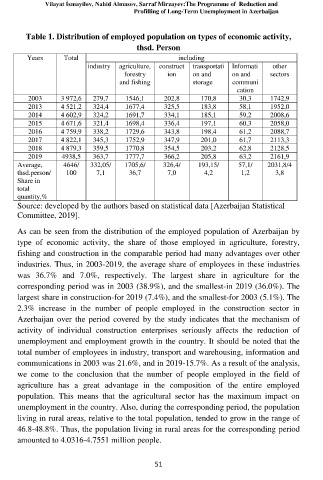
                    As can be seen from the distribution of the employed population of Azerbaijan by
                    type  of  economic  activity,  the  share  of  those  employed  in  agriculture,  forestry,
                    fishing and construction in the comparable period had many advantages over other
                    industries. Thus, in 2003-2019, the average share of employees in these industries
                    was  36.7%  and  7.0%,  respectively.  The  largest  share  in  agriculture  for  the
                    corresponding period was in 2003 (38.9%), and the smallest-in 2019 (36.0%). The
                    largest share in construction-for 2019 (7.4%), and the smallest-for 2003 (5.1%). The
                    2.3%  increase  in  the  number  of  people  employed  in  the  construction  sector  in
                    Azerbaijan  over  the  period  covered  by  the  study  indicates  that  the  mechanism  of
                    activity  of  individual  construction  enterprises  seriously  affects  the  reduction  of
                    unemployment and employment growth in the country. It should be noted that the
                    total number of employees in industry, transport and warehousing, information and
                    communications in 2003 was 21.6%, and in 2019-15.7%. As a result of the analysis,
                    we  come  to  the  conclusion  that  the  number  of  people  employed  in  the  field  of
                    agriculture  has  a  great  advantage  in  the  composition  of  the  entire  employed
                    population.  This  means  that  the  agricultural  sector  has  the  maximum  impact  on
                    unemployment in the country. Also, during the corresponding period, the population
                    living in rural areas, relative to the total population, tended to grow in the range of
                    46.8-48.8%. Thus, the population living in rural areas for the corresponding period
                    amounted to 4.0316-4.7551 million people.


                                                           51

